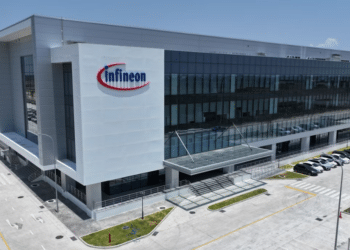


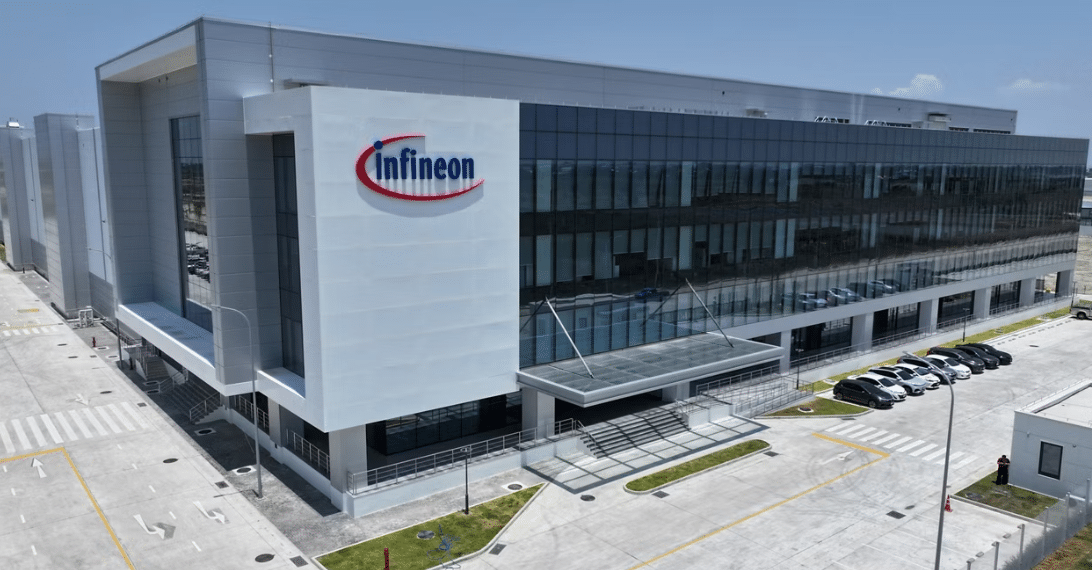
German chipmaker Infineon Technologies AG (FSE: IFX) has opened a new semiconductor backend manufacturing facility near Bangkok, Thailand, expanding its production footprint in Southeast Asia as demand grows for power semiconductors used in electric vehicles, energy systems and data centers.
The facility in Samut Prakan officially opened on October 1, 2026, with the first phase, known as Module A, beginning operations. The site is part of a planned five-module expansion that Infineon says will allow it to scale manufacturing capacity over time and strengthen supply-chain resilience.
The company has invested more than €100 million in the initial backend facility. The broader expansion in Thailand is expected to involve an investment of about 48 billion baht, or roughly $1.4 billion, across the planned modules.
Backend Capacity for Power Semiconductors
The Bangkok facility is a backend manufacturing site rather than a front-end wafer fabrication plant. Its operations will include semiconductor assembly, packaging and testing, processes that turn completed wafers into packaged and tested chips ready for use in electronic systems.
Module A occupies part of a 200,000-square-meter land parcel and initially provides up to 30,000 square meters of cleanroom space. The site has been designed to expand to as much as 150,000 square meters of cleanroom capacity as additional modules are added.
Infineon describes the facility as a next-generation backend hub built around automation, scalable manufacturing and advanced semiconductor packaging and testing capabilities.
The site will focus on power modules and discrete semiconductors, wafer testing and research and development. These technologies are used across electric vehicles, charging infrastructure, renewable-energy systems, industrial applications and data centers.
The expansion comes as power management becomes increasingly important across electrification and digital infrastructure. EVs require power semiconductors for power conversion and motor control, while data centers use them in power supplies and energy-management systems.
Dual Sourcing Adds Supply-Chain Resilience
A key objective of the Thailand investment is to diversify Infineon’s manufacturing network.
The company plans to use the Thailand operation alongside its existing manufacturing presence in Malaysia, creating a dual-sourcing structure for selected products. Such geographic redundancy can provide customers with alternative production capacity when individual sites face operational or logistical disruptions.
Infineon Chief Operating Officer Alexander Gorski has described the Thailand investment as a long-term strategic move, citing the country’s logistics infrastructure, established electronics supply chain and position in Asia.
The new facility adds another manufacturing location to Infineon’s global network, which spans Europe, the United States, China and Southeast Asia.
For semiconductor manufacturers, geographic diversification has become an increasingly important consideration as companies seek to manage disruptions involving logistics, trade restrictions, geopolitical tensions and fluctuations in regional production capacity.
Facility Targets Lower Environmental Impact
The Bangkok site has also been designed with environmental considerations in mind.
Infineon says the facility is designed to operate using 100% green electricity. It also has a target of recycling 25% of its water consumption and includes rainwater harvesting infrastructure.
The combination of expanded capacity and resource-efficiency measures reflects the growing importance of energy and water management in semiconductor manufacturing, where cleanrooms, cooling systems and production equipment can require significant amounts of electricity and water.
Thailand Seeks Larger Role in Semiconductor Supply Chain
Infineon’s investment comes as Thailand attempts to strengthen its position in the global semiconductor and advanced electronics industry.
The country’s semiconductor strategy targets investment across areas including power electronics, photonics, sensors, advanced packaging and testing. The government has also set long-term investment and workforce-development targets aimed at building a broader semiconductor ecosystem.
Thailand has attracted substantial investment commitments in semiconductors and advanced electronics in recent years, supported by incentives from its Board of Investment. Officials have indicated that the country intends to attract more upstream semiconductor manufacturing while continuing to expand its backend capabilities.
Infineon’s facility adds to that effort by bringing high-volume semiconductor backend manufacturing and R&D capabilities to the country.
Thailand Could Become a Future Manufacturing Base
For now, Infineon’s Thailand operations remain focused on backend manufacturing, wafer testing and R&D. However, the company has indicated that Thailand could eventually have a role in front-end semiconductor manufacturing as well.
A future wafer fabrication plant remains a longer-term possibility and is not expected within the next three years. Any such development would represent a significant expansion of Thailand’s role in Infineon’s manufacturing chain, given the substantially higher capital and infrastructure requirements associated with front-end wafer production.
The immediate priority is expanding the Bangkok backend hub. With five modules planned and substantial room for additional cleanroom capacity, the site gives Infineon the ability to increase production as demand develops.