

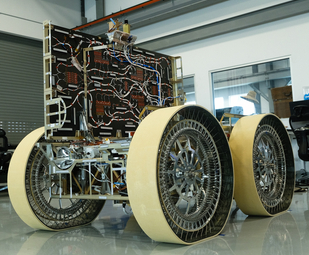
Astrolab has announced the NASA payloads selected for its upcoming lunar mission, which will mark the first deployment of the company’s FLIP rover on the Moon.
The mission is scheduled for launch in late 2026 aboard Astrobotic’s Griffin-1 lunar lander as part of NASA’s Commercial Lunar Payload Services (CLPS) initiative.
Griffin-1 is expected to deliver payloads to the Moon’s south pole region, supporting NASA’s Artemis program aimed at returning astronauts to the lunar surface.
FLIP, short for FLEX Lunar Innovation Platform, is Astrolab’s compact rover platform designed for small payload delivery and autonomous mobility operations on the Moon. The mission will serve as the rover’s first lunar demonstration while also collecting operational and engineering data for future Artemis missions.
NASA payloads onboard FLIP will include instruments from multiple NASA research centers focused on lunar exploration, navigation, resource assessment, and dust monitoring.
One of the payloads comes from NASA Ames Research Center. Known as Moon Exploration for Titanium with Active Lighting (METAL), the instrument includes a multicolor camera and radiometer developed in partnership with Interlune. The payload is designed to estimate helium-3 concentrations in lunar regolith to support future lunar resource assessment efforts.
NASA Goddard Space Flight Center will contribute a Laser Retroreflector Array (LRA). The device will enable precision tracking of the rover’s location through reflected laser signals from orbiting spacecraft. According to Astrolab, the array requires no electrical power or maintenance and will remain on the Moon as a permanent location marker after the mission ends.
Another payload comes from NASA Johnson Space Center. The Lunar Dust level sensor and Effects on Surfaces (LDES) instrument will study how lunar dust affects equipment performance, including thermal systems and solar arrays. The data will support predictive modeling for future lunar habitats and long-duration missions.
NASA Marshall Space Flight Center will provide a hardened LiDAR system designed for lunar conditions. The payload will generate high-resolution 3D surface maps for navigation, hazard detection, and obstacle avoidance.
Jaret Matthews, founder and CEO of Astrolab, said the company’s FLIP platform allows multiple NASA investigations to operate within a single mobile mission architecture.
He said the mission would help support future Artemis exploration activities on the lunar surface.
Unlike larger lunar rovers, FLIP is designed to operate without a deployment ramp. The rover can directly exit from the top of the lander, a design Astrolab said reduces mission complexity and increases landing flexibility.
In addition to transporting payloads, FLIP will gather engineering and operational data to support development of Astrolab’s larger FLEX rover platform. The FLEX rover is being designed for future Artemis missions and commercial lunar operations.