


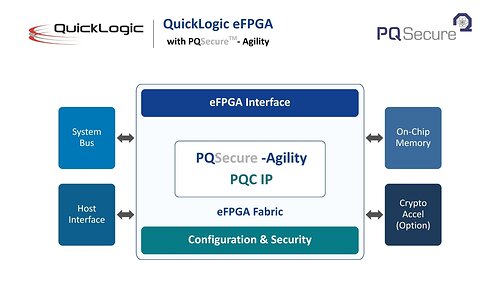
QuickLogic Corporation (Nasdaq: QUIK) and PQSecure Technologies have demonstrated a reprogrammable post-quantum cryptography (PQC) solution for system-on-chip (SoC) designs. The companies said the approach allows security algorithms to be updated without redesigning silicon.
The collaboration integrated PQSecure’s CRYSTAL-1000C post-quantum cryptographic IP core with QuickLogic’s embedded FPGA (eFPGA) Hard IP fabric. The implementation targeted the Intel 18A process node and supports the U.S. National Institute of Standards and Technology’s (NIST) FIPS 203 (ML-KEM) and FIPS 204 (ML-DSA) standards.
According to the companies, the CRYSTAL-1000C core was successfully placed and routed within eFPGA IP blocks already used in customer ASICs. The implementation delivered sufficient performance for most applications while leaving additional capacity for higher-performance configurations and advanced security features.
The companies said the work addresses a growing challenge facing semiconductor designers as the industry prepares for the transition to post-quantum cryptography.
NIST plans to phase out vulnerable classical cryptographic algorithms by 2030, with the migration expected to be completed by 2035. Security experts have also warned of “harvest now, decrypt later” attacks, where encrypted data collected today could be decrypted once quantum computers become practical.
Unlike fixed-function cryptographic engines, QuickLogic’s eFPGA Hard IP allows security functions to be updated in the field. Developers can load new bitstreams to change algorithm parameters, deploy hybrid classical and post-quantum security, or address newly discovered vulnerabilities without requiring a new chip.
PQSecure’s CRYSTAL-1000C architecture is designed to support a range of deployment requirements. Using QuickLogic’s Aurora programming tools, SoC designers can determine the optimal eFPGA configuration based on application, performance and power requirements.
The remaining programmable resources can also be used for additional side-channel attack protections, including masking and hiding techniques.
QuickLogic said its Australis IP Generator produces application-specific eFPGA Hard IP for advanced semiconductor process nodes. The company said the technology offers improved power, performance and area efficiency compared with soft eFPGA implementations.
“The post-quantum cryptography transition is an evolving process, not a single event,” said Trey Peterson, Field Applications Engineer at QuickLogic. He said reprogrammable security helps designers avoid costly silicon re-spins as cryptographic standards evolve.
Luke Beckwith, Senior Hardware Engineer at PQSecure Technologies, said combining CRYSTAL-1000C with QuickLogic’s reconfigurable hardware enables customers to update security capabilities without requiring new tape-outs.
According to MarketsandMarkets, the global post-quantum cryptography market is expected to grow from $420 million in 2025 to more than $2.8 billion by 2030, driven by increasing adoption of quantum-resistant security technologies.