


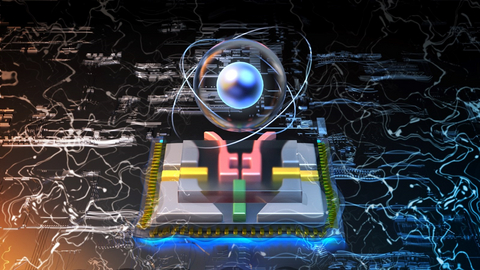
A team of researchers at Argonne National Laboratory has reported a significant advance in quantum computing hardware, demonstrating an experimental qubit platform with noise levels far below those of most existing technologies.
The study, conducted in collaboration with the University of Notre Dame and published in Nature Electronics, details a novel approach that traps single electrons on the surface of frozen neon gas. The results show that this architecture can reduce environmental noise—one of the key barriers to quantum performance—by factors ranging from 10 to as much as 10,000 compared with conventional semiconductor-based qubits.
Noise remains a central challenge in quantum computing. Qubits, unlike classical bits, are highly sensitive to disturbances such as electromagnetic interference, thermal fluctuations, and atomic vibrations. These factors limit coherence time and increase the likelihood of computational errors, constraining the scalability of quantum systems.
Most current quantum platforms rely on semiconducting or superconducting materials. While these have enabled early-stage systems, they are prone to noise arising from material defects, charge impurities, and fabrication variability. Addressing these limitations has become a priority as the industry moves toward practical, large-scale quantum computing.
The Argonne-developed platform adopts a different material strategy. Solid neon, described by researchers as chemically inert and largely free of impurities, provides a cleaner and more stable environment for qubit operation. By isolating electrons on this surface, the system minimizes interactions that typically degrade qubit performance.
To quantify these effects, the research team carried out a systematic noise characterization at the Center for Nanoscale Materials, a DOE Office of Science user facility. The process involved applying controlled microwave pulse sequences to manipulate the qubits and measure their response across a range of frequencies. The resulting data confirmed substantially lower noise levels relative to established platforms.
Beyond performance gains, the researchers highlighted potential manufacturing advantages. The electron-on-neon approach is expected to involve a simpler fabrication process than traditional semiconductor or superconducting qubits, which often require complex material engineering and precision layering techniques.
While the platform remains at an experimental stage, the findings suggest a viable path toward more stable and scalable quantum systems. Researchers say further work will focus on improving coherence times and integrating the technology into larger architectures.