

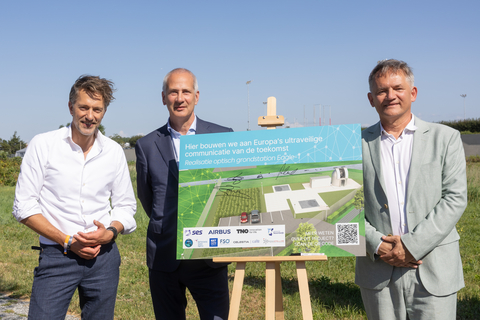
SES, Airbus Netherlands B.V. and the municipality of Noordwijk in the Netherlands have signed a ground lease agreement to develop an optical ground station (OGS) for the EAGLE-1 satellite project, aimed at advancing quantum-safe communications in Europe.
The facility will be located at the NL Space Campus, adjacent to the European Space Agency’s (ESA) technical centre ESTEC in Noordwijk. Airbus will build the station for SES, which will serve as the primary ground connection for the EAGLE-1 system.
The optical ground station will include a control room and a dome equipped with a high-precision telescope designed to establish laser communication links with satellites. The facility will also feature advanced optical systems capable of correcting atmospheric disturbances in real time, including turbulence caused by temperature changes and air movement.
The station will support the transmission of quantum-safe encryption keys through laser technology, enabling secure communications for users such as government organisations and financial institutions.
“Once operational, the system will allow early adoption of quantum-safe technology by users such as government and banking sector, enabling next-generation cybersecurity,” said Xavier Bertran, Chief Product and Innovation Officer at SES.
The EAGLE-1 project is a European initiative designed to demonstrate end-to-end quantum-secure communication using satellite technology. The system combines a satellite, ground infrastructure and laser-based communication links to support Quantum Key Distribution (QKD).
Unlike conventional satellite communication systems that rely on radio frequencies, EAGLE-1 uses laser beams to transmit cryptographic keys over long distances. The technology is designed to enhance security by enabling quantum-based encryption methods.
SES is managing the EAGLE-1 system through a public-private partnership with ESA and the European Commission. The project is expected to provide European organisations with early access to quantum communication capabilities as cybersecurity threats continue to evolve.
The optical ground station is being delivered by prime contractor TNO, which is also responsible for advanced optics. Several technology partners are contributing to the station’s development, including FSO Instruments for sensor technology, Airbus Netherlands for the real-time control system, Officina Stellare for the telescope and dome, and Celestia STS for the optical digital modem.