

Global smartphone shipments declined 4% year-on-year in the second quarter of 2026 as a prolonged memory supply crisis disrupted production and increased component costs, according to new research from Omdia. Despite the broader market slowdown, Apple (NASDAQ: AAPL) and Samsung Electronics (KRX: 005930) expanded shipments and strengthened their market positions.
The research firm said the market has become increasingly polarized as smartphone vendors adopt different strategies to manage rising component costs, supply shortages and changing consumer demand.
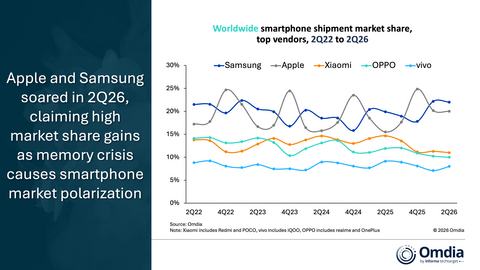
Samsung retained its position as the world’s largest smartphone vendor during the quarter with a 22% market share. The company increased its share by two percentage points from a year earlier, supported by stable product availability and resilient demand.
Omdia said the delayed launch of Samsung’s Galaxy S26 series shifted some premium smartphone demand into the second quarter. Samsung also strengthened its position in the budget segment as several Chinese manufacturers reduced their product portfolios and raised device prices to offset higher production costs.
Apple recorded its strongest-ever second-quarter performance, capturing a record 20% market share. The company increased its share by four percentage points compared with the same period last year.
According to Omdia, the iPhone 17 series drove one of Apple’s strongest upgrade cycles to date. Apple also maintained stable smartphone pricing during the quarter while many competing brands increased retail prices to reflect higher manufacturing costs.
The research firm noted, however, that Apple’s pricing strategy could face pressure later this year after the company increased prices across several other product categories toward the end of the quarter.
Outside the top two vendors, market conditions remained challenging. Xiaomi (HKEX: 1810) retained third place with an 11% market share, followed by OPPO with 10% and vivo with 8%.
Omdia attributed much of the market weakness to the sub-$400 smartphone segment, where vendors are facing the greatest pressure from higher memory prices, lower profit margins and price-sensitive consumers.
“The steepest volume drops hit the sub-$400 mass market segment, where supply constraints are tightest, profit margins are slimmest, and price sensitivity is highest,” said Runar Bjorhovde, Principal Analyst at Omdia.
He said manufacturers are increasingly prioritizing profitability over shipment volumes by streamlining product portfolios and adjusting retail prices.
According to Omdia, memory prices have increased sharply over the past year, with some smartphone vendors paying four to five times more than they did a year earlier. Memory and storage now account for more than 60% of the bill of materials for entry-level smartphones and more than 30% for premium devices.
The research firm added that the industry is also facing additional semiconductor supply constraints, including bottlenecks at chip foundries, further increasing production costs.
Le Xuan Chiew, Research Manager at Omdia, said memory prices are unlikely to ease before the second half of 2027 and are not expected to return to levels seen before 2025.
He said vendors’ current pricing and portfolio adjustments should be viewed as long-term strategic changes rather than temporary responses to supply disruptions.
Looking ahead, Omdia expects market conditions to remain difficult through the next two quarters, when seasonal demand from flagship launches, holidays and major shopping festivals coincides with constrained memory supply.
Bjorhovde said manufacturers are likely to place greater emphasis on premium devices to protect margins during the peak sales season. That strategy, however, may reduce affordable options for budget-conscious buyers.
As a result, some consumers may postpone smartphone purchases, choose lower-specification models, rely on financing options or turn to refurbished devices as higher prices continue to reshape the global smartphone market.