

The global humanoid robot industry is entering a new phase, with competition shifting from engineering breakthroughs to commercial execution, according to a new analysis by TrendForce. As companies move beyond prototype development, the race is increasingly being defined by artificial intelligence, manufacturing scale and control over critical components.
The market research firm says the industry’s centre of gravity is moving from hardware innovation to business viability. Success will depend not only on building capable robots, but also on securing supply chains, lowering production costs and collecting the operational data needed to continuously improve machine performance.
TrendForce identifies a widening strategic divide between the world’s two largest humanoid robotics markets. The United States is betting on advances in artificial intelligence to give its robots greater adaptability, while China is leveraging its manufacturing ecosystem to accelerate production and deployment.
For US companies, the competitive edge lies in software. Rapid progress in generative AI, Vision-Language-Action (VLA) models and world models is reshaping the industry’s priorities, with intelligence increasingly outweighing hardware specifications. Future humanoid robots will need to interpret complex environments, plan multi-step tasks and adapt to unfamiliar situations with minimal human intervention.
That strategy is supported by a broad AI ecosystem. NVIDIA continues to expand its Physical AI portfolio through Cosmos, Isaac Lab and GR00T, while Google DeepMind has introduced Gemini Robotics to improve robotic reasoning and environmental understanding. OpenAI is also investing in embodied AI research, adding to an ecosystem that spans foundation models, simulation software, robotics platforms and AI computing hardware.
The shift is also evident in the strategies of robotics developers. Tesla is validating Optimus Gen 3 in manufacturing environments while refining AI models designed to operate across different workplace settings. Figure AI is partnering with industrial customers to train its systems using factory data. Boston Dynamics is integrating advanced AI into its established motion-control technologies, while Apptronik is using data from commercial deployments to strengthen Google’s Gemini Robotics models.
TrendForce says these companies are building a “data flywheel”, where every real-world deployment generates new information that improves AI models and enhances future robot performance.
China, by contrast, is pursuing a manufacturing-led strategy. TrendForce compares its approach to the early expansion of the country’s electric vehicle industry, where vertically integrated supply chains and rapid localisation of components helped drive down costs and accelerate commercial adoption.
Chinese manufacturers have strengthened domestic production of core components, including servo motors, reducers and lithium batteries. According to the report, that has shortened product development cycles and enabled companies to move from design validation to large-scale manufacturing at a faster pace.
The report highlights Unitree and Agibot as examples of that approach. Unitree has established itself through rapid product development and competitive pricing across quadruped and humanoid robots. Agibot expanded production from 1,000 to 5,000 units in roughly a year before doubling capacity to 10,000 units within three months, underscoring the speed at which Chinese manufacturers are scaling operations.
TrendForce argues that China’s advantage now extends beyond manufacturing costs. The country’s mature supplier network enables faster component validation, pilot production and mass manufacturing, reducing the time required to bring new products to market.
Large-scale deployment is also creating another strategic asset: data. As humanoid robots are introduced into factories, logistics centres and public spaces, they continuously generate operational information that can be used to improve AI models. TrendForce believes this feedback loop could gradually narrow the software gap between Chinese and US developers.
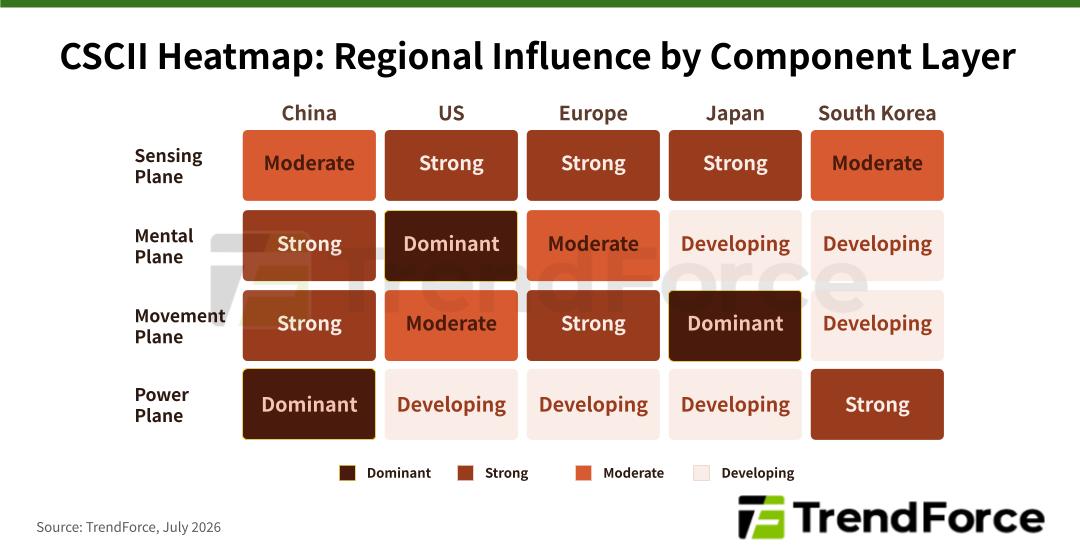
Beyond AI capabilities, supply chain control is emerging as a defining competitive factor. To assess regional strengths, TrendForce has developed the Component Supply Chain Influence Index (CSCII), which evaluates suppliers across five criteria, including manufacturing scale, technological barriers, commercial adoption, production capacity and geopolitical resilience.
China recorded the broadest presence across the industry’s supply chain, leading the Power Plane while earning strong ratings in both the Mental and Movement Planes. TrendForce attributes that position to the country’s manufacturing depth and extensive supplier ecosystem.
The United States retained the strongest position in the Mental Plane, driven by companies such as NVIDIA and Qualcomm, whose processors and AI computing platforms remain central to advanced robotics development.
Europe ranked strongly in sensing and movement technologies, supported by its expertise in precision engineering. German suppliers, in particular, maintain a leading position in encoder technologies. Japan continues to dominate mechanical transmission systems, while South Korea’s strengths remain concentrated in batteries, backed by investments from companies including LG and Samsung.
TrendForce concludes that the humanoid robot industry is entering a period where no single technological advantage will determine market leadership. Artificial intelligence, manufacturing capability, supply chain resilience and access to operational data are becoming equally important.