

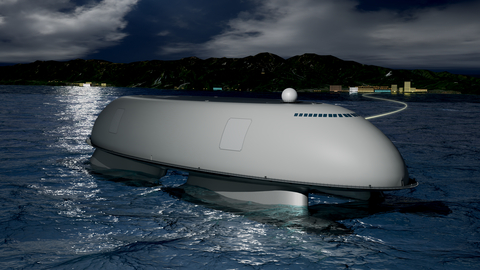
Optimal Transit has unveiled a second configuration of its Kraaken maritime infrastructure platform, combining offshore power generation, desalination and AI data-centre capacity in a single vessel designed to operate without fuel or a conventional grid connection.
The new Blue Economy VITAL 100 MW configuration reallocates part of the vessel’s power output from computing to utility services. The company said the platform can export up to 40 MW of continuous baseload electricity, produce about 30 million litres of fresh water a day and retain 60 MW for AI-grade data-centre operations.
Optimal Transit is a maritime technology partnership between InMar Technologies and OptiFuel Systems. The announcement follows the company’s July introduction of Kraaken as a self-powered maritime AI data-centre platform.
The VITAL configuration retains the platform’s small waterplane area twin hull (SWATH) architecture, which is designed to provide stability in offshore environments, along with its Digital Ocean Thermal (DOT) self-powering engine. The company said the system uses commercially available components with established operating histories in industrial and maritime applications.
The central proposition is flexibility. Rather than building separate infrastructure for power generation, water treatment and data centres, Optimal Transit is positioning the vessel as a mobile infrastructure platform whose output can be adjusted according to the requirements of a host location.
In the VITAL 100 MW configuration, up to 40 MW of electricity can be delivered to shore, which Optimal Transit estimates would be sufficient to serve approximately 32,000 homes. Its desalination system is designed to produce roughly 7.9 million gallons of fresh water per day, enough for an estimated 150,000 people.
The remaining 60 MW is allocated to AI and data-centre workloads, potentially supporting sovereign computing requirements for coastal cities, governments and infrastructure operators.
Power, water and computing services would be connected to shore through a quick-disconnect umbilical system. The company said the vessel can disconnect and relocate if conditions require it, before reconnecting at another location.
That mobility is also central to the platform’s proposed disaster-response application. Optimal Transit points to regions vulnerable to hurricanes, earthquakes and other disruptions where terrestrial power and water infrastructure can take months or years to restore.
The company cited Puerto Rico’s experience following Hurricane Maria in 2017, when widespread damage to the electricity network contributed to a prolonged recovery. Optimal Transit argues that an offshore utility platform could provide an independent source of electricity and freshwater while damaged terrestrial infrastructure is being repaired.
The economics are another part of the proposition. Optimal Transit estimates the VITAL 100 MW vessel would require approximately $587 million in capital expenditure. It compares this with an estimated $750 million to $1.33 billion for a land-based combination of a 40 MW power plant, a 7.9-million-gallon-per-day desalination facility and a 60 MW AI data-centre shell.
The company estimates that the offshore platform could be operational in about three years, compared with six to 10 years for the comparable land-based projects. Those estimates include potential grid interconnection, permitting and zoning requirements associated with conventional infrastructure, according to Optimal Transit.
The platform is also being positioned for markets where unreliable electricity grids force businesses and households to depend on diesel generation. Optimal Transit estimates diesel-based self-generation in parts of sub-Saharan Africa, South and Southeast Asia and Pacific Island markets can cost between $0.40 and $0.55 per kWh.
Beyond individual deployments, the company is proposing a multi-vessel model it calls a “Sovereign Power Park”. Five VITAL 100 MW vessels operating within a two-mile offshore zone would collectively provide approximately 200 MW of baseload electricity, 40 million gallons of fresh water per day and 300 MW of data-centre capacity.
The model would allow the same offshore infrastructure to serve utility, industrial, computing or emergency-response requirements depending on the deployment.
For Optimal Transit, the broader strategy is to treat mobility as an infrastructure asset. A vessel can be relocated when a project ends, weather conditions deteriorate or requirements change, potentially allowing the capital asset to move between markets rather than remaining tied to a single site.
The proposition also comes as AI data-centre developers face growing constraints around power availability, land, water and grid connections. By combining computing with self-generated power and desalinated water, Kraaken is seeking to address several of those constraints within one offshore platform.
The commercial model, however, remains dependent on the company’s ability to demonstrate the claimed generation, desalination, data-centre and mobility capabilities at scale.