

Researchers at Pusan National University in South Korea have developed a 3D-printing method that allows the same soft-material filament to either contract or elongate when heated, potentially expanding the design options for soft robots, wearable devices and biomedical tools.
The study, led by Professor Suk-kyun Ahn with researchers from Oak Ridge National Laboratory in the US, introduces what the team describes as the first 3D-printable smectic liquid crystal elastomer (LCE) ink capable of switching its molecular alignment during printing.
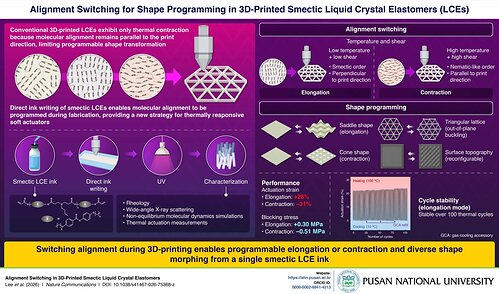
The work, published in Nature Communications after being made available online on July 10, 2026, addresses a limitation in conventional extrusion-based printing of liquid crystal elastomers. Molecules within a printed filament typically align along a fixed direction during extrusion, which determines how the material responds to heat.
The new approach allows that alignment to be changed during printing by adjusting printing speed or temperature. The researchers demonstrated that molecular orientation could be switched between two perpendicular directions, enabling the same material to produce opposite movements when heated.
“Our work provides the first demonstration of switching molecular alignment between two orthogonal directions using a single 3D-printable smectic LCE ink, simply by tuning the printing speed and temperature,” Ahn said.
The distinction is important for soft actuators, where controlled deformation is used to generate movement. A filament programmed to contract can produce a different mechanical response from one programmed to elongate, allowing designers to create more complex motions without having to use different materials or separately manufactured components.
To establish how the switching mechanism worked, the researchers combined direct ink writing with rheological measurements, wide-angle X-ray scattering and molecular dynamics simulations. These techniques allowed the team to examine how the ink behaved during extrusion and how its molecular structure responded to changes in printing conditions.
The researchers subsequently used the material to fabricate two- and three-dimensional structures with programmable shape changes. Demonstrations included lattices, curved structures and surfaces capable of changing their topography.
The printed structures also maintained their performance through repeated heating and cooling cycles, an important consideration for applications requiring repeated actuation rather than one-time deformation.
Ahn said the technology could eventually be used in soft robotic actuators and artificial muscles, as well as reconfigurable surfaces for haptic displays. Other potential applications include adaptive textures that can alter aerodynamic drag, wearable devices and minimally invasive medical tools designed to change shape after deployment.
The ability to programme both expansion and contraction within a single printed filament could also simplify the construction of soft machines. Instead of assembling multiple actuating materials with different responses, engineers could potentially create different mechanical behaviours within one printing process by varying parameters such as speed and temperature.
The research also adds to the development of 4D printing, where printed structures are designed to change their shape or properties in response to external stimuli. Heat-responsive liquid crystal elastomers are among the materials being explored for such applications because their molecular alignment can translate thermal changes into controlled mechanical movement.
However, the technology remains at the laboratory stage. The study used a single smectic LCE formulation under controlled experimental conditions, and the researchers said additional work is required to determine whether the approach can be extended to other materials and adapted for larger-scale manufacturing.
Ahn said that over the next five to 10 years, the approach could help move 3D-printed structures beyond passive components towards objects capable of changing shape and performing specific functions.
For soft robotics and biomedical engineering, the advance points towards a manufacturing approach in which the behaviour of a material can be programmed during printing rather than determined solely by its composition or post-processing.