

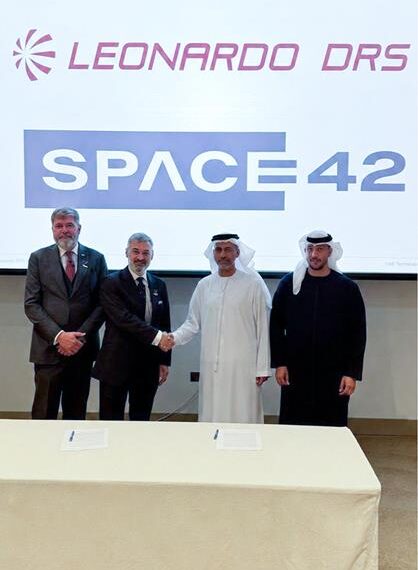
Space42 (ADX: SPACE42) and Leonardo DRS (Nasdaq: DRS) have signed a memorandum of understanding to explore the integration of secure satellite communications with advanced mission systems for the United Arab Emirates, as governments increasingly seek sovereign and resilient defence networks.
The agreement establishes a framework under which Leonardo DRS will contribute expertise in C5ISR mission systems, while Space42 will provide secure, AI-enabled satellite communications and beyond-line-of-sight connectivity. The companies will assess opportunities to co-design and integrate mission capabilities tailored to UAE requirements.
The partnership comes as military operations become increasingly dependent on connected systems capable of sharing information across land, air, maritime and space-based platforms. For the UAE, the companies said the collaboration could strengthen sovereign communications infrastructure while improving situational awareness and supporting decision-making in complex security environments.
“Being a trusted leader and pioneer in secure connectivity is a strategic priority for Space42 as we set the standard for resilient, mission-ready networks,” said Ahmed AlMehrzi, chief commercial officer, Government Business, Space42. He said combining the company’s satellite infrastructure and AI communications capabilities with Leonardo DRS mission systems would strengthen protected communications and the UAE’s national security ecosystem.
Leonardo DRS Senior Vice President and General Manager of Ground Electronics Denny Crumley said the agreement supports the company’s efforts to address the UAE’s national security priorities through advanced integration capabilities.
At the centre of the collaboration is C5ISR — command, control, communications, computers, cyber, intelligence, surveillance and reconnaissance — technology. Such systems integrate information from multiple sensors and platforms to give commanders and operators a more comprehensive view of rapidly changing operational environments.
Leonardo DRS develops mission management systems, network computing and vehicle integration technologies for US military and allied forces. Its portfolio includes tactical computing, intelligent displays, AI processing and integrated C4/C5/C6ISR systems designed to provide real-time situational awareness across multiple platforms.
Space42 brings a different layer of the technology stack. The Abu Dhabi-based company combines satellite communications, geospatial analytics and AI, providing secure connectivity and space-based services for government and commercial customers.
The companies said the combination could extend protected communications beyond terrestrial networks while enabling continuous connectivity for national security operations. Beyond-line-of-sight communications are particularly relevant to forces operating outside conventional terrestrial communication coverage.
Space42 was formed in 2024 through the merger of Bayanat and Yahsat. Its operations are divided between Space Services, which focuses on satellite operations and fixed and mobile satellite services, and Smart Solutions, which combines geospatial data with AI-based processing.
The partnership also reflects the growing role of space infrastructure in national defence strategies. Secure satellite links can provide communications resilience when terrestrial networks are disrupted, while AI-enabled processing can help turn large volumes of operational data into information for commanders and other users.
For Leonardo DRS, the agreement expands its international engagement with a strategic partner in the Gulf. For Space42, integrating its satellite communications capabilities with established defence mission systems could broaden the role of its space infrastructure in sovereign security applications.
The MoU does not constitute a final commitment to a specific programme. The companies will first examine the feasibility of jointly developing and integrating mission capabilities for the UAE.
If the collaboration progresses into operational programmes, it could provide a pathway for combining sovereign satellite connectivity with tactical mission systems, bringing space-based communications closer to the core of integrated national security infrastructure.