

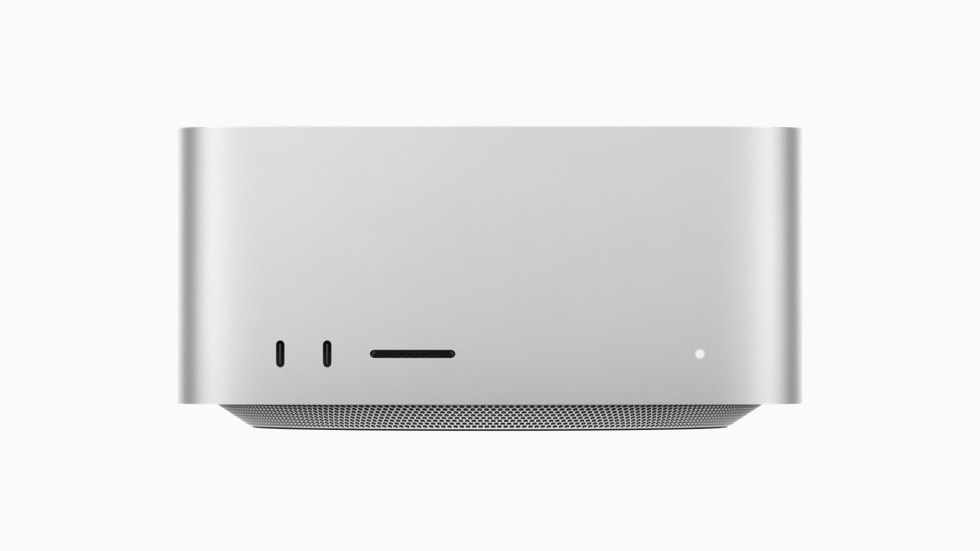
Apple (NASDAQ: AAPL) has introduced a new Mac Studio powered by its M5 Max and all-new M5 Ultra chips, positioning the compact desktop as a high-performance platform for on-device artificial intelligence, professional graphics and demanding data-intensive workloads.
The new Mac Studio, announced Aug. 25, comes with substantially higher processing, graphics and AI capabilities than its predecessors. Apple says the system delivers up to 4.3 times faster AI performance, up to twice the storage performance, up to 1.8 times faster graphics and up to 1.3 times faster CPU performance, depending on configuration and workload.
The company is targeting the machine at developers, creative professionals, AI researchers, data scientists and other users working with large datasets and computationally intensive applications. Preorders began Aug. 25, with customer deliveries and retail availability scheduled to begin Sept. 22. Models equipped with 512GB of unified memory are expected to arrive in late October.
Mac Studio with M5 Max starts at $2,499 in the U.S., while the M5 Ultra configuration starts at $5,499. Education pricing starts at $2,299 and $5,099, respectively.
Apple Pushes Mac Studio Further Into On-Device AI
The centerpiece of the new system is Apple’s emphasis on running AI workloads locally. The M5 Max configuration includes an 18-core CPU, up to a 40-core GPU and as much as 128GB of unified memory. The M5 Ultra takes those specifications substantially higher, with up to a 36-core CPU, an 80-core GPU and up to 512GB of unified memory.
Apple has incorporated Neural Accelerators directly into each GPU core, a change it says is designed to improve matrix multiplication and accelerate AI workloads. According to Apple, the M5 Max delivers up to 3.9 times the AI performance of the previous generation, while the M5 Ultra reaches up to 4.3 times the peak AI compute performance of the M3 Ultra and 9.8 times that of the M1 Ultra.
The M5 Ultra also offers up to 1.2 terabytes per second of unified memory bandwidth, 50% higher than the previous generation. Apple is using the large memory capacity and bandwidth to target workloads involving large language models, image generation, AI coding and other applications that can be constrained by local memory.
That approach comes as AI workloads increasingly move beyond conventional cloud-based applications. Running models locally can reduce reliance on remote computing infrastructure and allow organizations to keep sensitive data on their own systems. It can also avoid some recurring costs associated with cloud-based AI services.
Multiple Mac Studios Can Be Clustered for AI
Apple is also extending Mac Studio beyond a single-machine configuration. Multiple systems can be connected through Thunderbolt 5 and remote direct memory access, creating a distributed environment for AI inference.
Apple says a cluster of four Mac Studio systems can deliver up to three times the AI inference performance of a single system. The architecture could appeal to developers and research teams that need additional AI capacity without moving workloads entirely into the cloud.
The company is building that capability around its broader software ecosystem. macOS 27 introduces Core AI, a framework designed to help developers build, run and deploy AI models on Apple silicon.
Apple’s open-source MLX machine-learning framework is also optimized for its chips and supports model training, fine-tuning and inference. Together with Xcode and other development tools, Apple is positioning the Mac Studio as a local AI development platform spanning experimentation, model training and deployment.
M5 Max Targets Professional Creative Workloads
The M5 Max version is also aimed at traditional professional workloads. Its 18-core CPU combines six super cores with 12 performance cores, while the GPU can be configured with up to 40 cores.
Apple says the GPU is up to 50% faster than the previous generation. The chip also introduces third-generation hardware-accelerated ray tracing for professional 3D, visual effects and design applications.
Improvements to shader cores are intended to increase parallel processing performance for real-time graphics and rendering. For video professionals, the Media Engine supports hardware-accelerated H.264, HEVC, ProRes and AV1 decoding.
Apple said the M5 Max can handle uncompressed 8K video workflows and multiple concurrent video streams.
The company cited several application-level gains. It said LLM prompt processing in LM Studio can be up to 10.7 times faster than on Mac Studio with M1 Max and up to 3.9 times faster than M4 Max. Text-to-image generation can be up to 7.4 times faster than M1 Max and 3.5 times faster than M4 Max.
M5 Ultra Targets High-End Computing
The higher-end M5 Ultra is designed for workloads requiring greater compute and memory capacity. Its 36-core CPU includes 12 super cores and 24 performance cores, while its GPU can scale to 80 cores.
Apple says the M5 Ultra provides up to 1.3 times higher multithreaded CPU performance than the M3 Ultra and up to 1.8 times faster graphics. Its Neural Accelerators are integrated into the Ultra GPU architecture for the first time, according to Apple.
The chip also doubles the number of video encode and decode blocks compared with M5 Max. Apple says this enables the system to simultaneously play up to 33 streams of 8K ProRes 422 video at 30 frames per second.
For AI workloads, Apple cited up to 15.4 times faster CopyCat ML training in Foundry Nuke compared with Mac Studio with M1 Ultra, and up to 3.3 times faster performance than M3 Ultra.
LLM prompt processing in LM Studio can be up to 9.8 times faster than M1 Ultra and four times faster than M3 Ultra, Apple said.
Faster Storage and Expanded Connectivity
Connectivity has also received an upgrade. Mac Studio now supports Thunderbolt 5, providing up to 120Gbps of bandwidth for external storage, displays and PCIe expansion systems.
The desktop also gains Wi-Fi 7 and Bluetooth 6 through Apple’s N1 wireless chip. Apple says the system can support up to eight displays, including as many as four Studio Display XDR monitors operating at 5K resolution and 120Hz.
The company has also added genlock over USB-C, enabling precise synchronization between displays and professional camera capture systems.
Storage performance is up to twice as fast, according to Apple, using a next-generation SSD architecture designed to speed up project loading, file transfers and large-model loading.
macOS 27 Adds AI Features
The new Mac Studio will run macOS 27, which includes expanded Apple Intelligence capabilities and Siri AI.
Apple says Siri AI can use personal context across applications and interact with information displayed on a user’s screen through Visual Intelligence. Apple Intelligence also adds AI-powered features across applications such as Safari, Photos and Shortcuts.
The software is intended to complement the hardware’s local AI capabilities, giving users access to AI tools without necessarily depending on external cloud infrastructure.
Pricing and Availability
Preorders for the new Mac Studio began Aug. 25 in 30 countries and regions, including the United States. The systems will begin reaching customers and Apple retail locations Sept. 22.
Mac Studio with M5 Max starts at $2,499, while M5 Ultra starts at $5,499. The 512GB unified-memory configuration is scheduled to become available in late October.
Apple is also offering its Apple Upgrade leasing program in the U.S., with Mac Studio with M5 Max starting at $48.99 per month and the M5 Ultra version at $110.10 per month on 36-month leases, excluding taxes and trade-in credits.
A Shift Toward Local AI Computing
The launch expands Apple’s strategy of using custom silicon and unified memory to bring increasingly demanding AI workloads onto desktop hardware.
The M5 Ultra’s 512GB memory ceiling and support for multi-system clustering push the Mac Studio into territory traditionally associated with high-end workstations and specialized AI infrastructure.
For professional users, the practical test will be how Apple’s claimed performance gains translate across real-world applications and whether local processing can provide a meaningful alternative to cloud-based AI computing.
The M5 Max gives Apple a lower entry point for developers and creative professionals, while the M5 Ultra targets users handling large AI models, advanced graphics, video production and scientific workloads. Together, the two configurations mark a significant expansion of what Apple expects a desktop Mac to handle as AI becomes increasingly central to professional computing.