

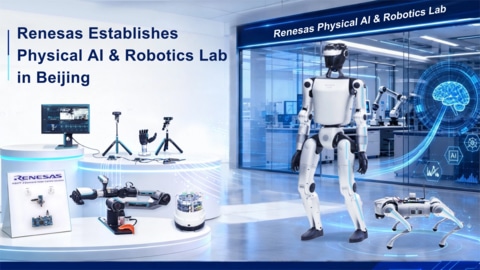
Renesas Electronics Corporation (TSE: 6723) has opened a dedicated Physical AI & Robotics Lab in Beijing, creating a facility for customers and technology partners to test and develop robotic systems as the semiconductor industry moves deeper into physical AI.
The company said the lab will support projects from proof-of-concept through deployment and will serve as a hub for its physical AI strategy in China. The facility brings together hardware, software, AI modeling, control, sensing, power management and system-level verification under one development environment.
Physical AI refers to AI systems that interact directly with the physical world. Unlike software-based AI applications, these systems must process sensor inputs, make decisions and control physical actions in real time. Robotics, including humanoid robots, is among the most visible applications of the technology.
For semiconductor suppliers, the shift creates demand across several areas of a robotic system. Processing, sensors, motor control, power management, connectivity and software must operate together while meeting requirements for reliability, safety and deterministic performance.
Renesas said it sees physical AI as a long-term growth opportunity. The company established its Physical AI Division on July 1, 2026, and the Beijing lab extends that strategy into a market that has become one of the world’s largest centers for robotics development and manufacturing.
Ivo Marocco, vice president and head of UX at Renesas, said the company currently addresses about 30% of the bill of materials of a humanoid robot and aims to increase that coverage to 70%.
The expansion would draw on Renesas’ capabilities in control, power, sensing, AI and software, as well as partnerships across the robotics ecosystem.
The Beijing facility is designed to provide more than product demonstrations. Renesas said customers will be able to validate complete systems and work with the company on co-development projects, allowing engineering teams to identify system-level issues earlier in the development cycle.
Yvonne Liu, vice president and president of Renesas China, said China’s robotics sector benefits from a large customer base, a collaborative technology ecosystem and an extensive supply chain. The company plans to use the lab to work with customers, universities, startups and other ecosystem participants.
The strategy reflects the increasingly integrated nature of robotics development. A humanoid robot, for example, requires multiple semiconductor functions working across its body, from processors handling AI workloads to motor-control systems managing movement and power devices supporting the electrical architecture.
Renesas is targeting that broader system opportunity through a portfolio covering processing and motion control, sensing, actuation and power management. Its experience in automotive and industrial applications also gives the company expertise in functional safety and reliability, areas that are particularly important as autonomous machines move into commercial and industrial environments.
The company is also combining its semiconductor portfolio with edge AI capabilities and Renesas 365, its cloud-based electronics development platform. The goal is to provide developers with tools spanning hardware design, software development and system deployment.
The Beijing lab comes as robotics companies and semiconductor suppliers increasingly focus on moving AI capabilities from data centers into machines capable of operating independently in real-world environments. That transition could expand the semiconductor content of robots while increasing the importance of system-level integration.
For Renesas, the immediate objective is to bring customers into the development process earlier and shorten the path from robotics concepts to deployable systems. The company expects the Beijing facility to play a central role in that effort as physical AI develops into a broader commercial market.