

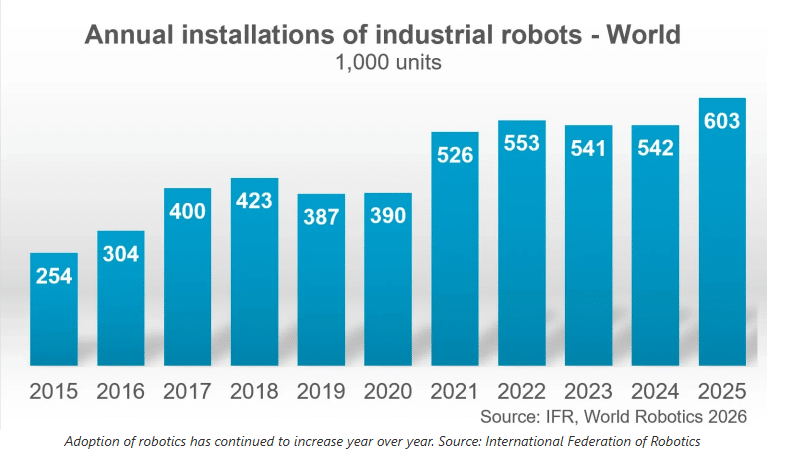
The number of industrial robots operating in factories worldwide rose 9% to a record 5 million units in 2025, as annual installations increased 11% to more than 600,000, according to the International Federation of Robotics.
Asia accounted for the strongest growth, led by China, while the Americas also expanded. Europe recorded slower growth, with several major manufacturing markets reporting declines.
“Industrial automation is progressing at high speed,” said Jane Heffner, president of the International Federation of Robotics. The global operational stock is now more than twice the level recorded seven years ago, she said.
China Accounts for 59% of Global Installations
China remained the world’s largest market for industrial robots, with installations rising 20% to 354,000 units in 2025. The country accounted for 59% of global installations, nearly 60,000 units above its previous annual record.
Chinese robot makers continued to increase their share of the domestic market. Their installations rose 15% to 195,000 units, giving them a 55% share of installations in China, compared with 57% in 2024.
Japan, the second-largest Asian market, installed 36,219 robots, down 19%. Its global ranking fell to third, behind the United States. The IFR expects demand to increase slightly, but said a major recovery is unlikely in the short to medium term.
South Korea installed about 30,000 robots, down 1%. Annual installations have remained around 31,000 units since 2019. The country remained the world’s fourth-largest market. New automotive investments expected in 2027 and 2028 could support higher robot demand.
India installed almost 10,500 robots, up 15%, making it the world’s sixth-largest market, behind Germany. From 2020 to 2025, installations grew at an average annual rate of 27%.
U.S. Overtakes Japan
The United States became the world’s second-largest industrial robot market in 2025, overtaking Japan. Installations rose 12% to almost 38,500 units, the country’s third-highest annual total on record.
Mexico recorded a 7% decline to fewer than 5,200 installations, marking a third consecutive year of decline. Canada installed almost 4,000 robots, up 5%, with an average annual growth rate of 9% between 2020 and 2025.
Brazil recorded a 38% increase to almost 4,300 units. Automotive manufacturers installed nearly 2,100 robots, up 212%. The increase was likely linked to investments by Chinese automakers in the country, according to the IFR’s assessment.
European Markets Contract
Germany remained Europe’s largest robotics market and the world’s fifth-largest. It accounted for 41% of industrial robot installations across the European Union.
German installations fell 8% to fewer than 25,000 units in 2025. From 2020 to 2025, installations across industries grew at an average annual rate of 2%. Automotive companies remained the largest users, although their share of installations is declining.
Italy, Europe’s second-largest market, recorded about 7,800 installations, down 11%. France ranked third with almost 4,500 units, down 8%, followed by Spain with about 4,300 units, down 15%.
Global Installations Seen Rising
Global industrial robot installations are forecast to rise 9% to 655,000 units in 2026 and reach 806,000 units by 2029, according to the IFR.
Manufacturing relocation, labor shortages and efforts to build more resilient supply chains are expected to support automation investment. Changes in trade and industrial policies across major economies could also influence where new manufacturing capacity is built.
The effect is likely to vary by region. Countries expanding domestic manufacturing or facing labor constraints may increase investment in automation, while established markets with weaker industrial demand could see slower installations.
Technology is also broadening the potential applications for industrial robots. Advances in artificial intelligence, machine vision and sensing are increasing robot capabilities, while simpler programming and system integration are lowering barriers to deployment.
The IFR expects these factors, together with demographic change, to support continued growth in industrial robotics. The projected increase in annual installations suggests the expansion of factory automation is likely to continue even as the pace varies across individual markets.