


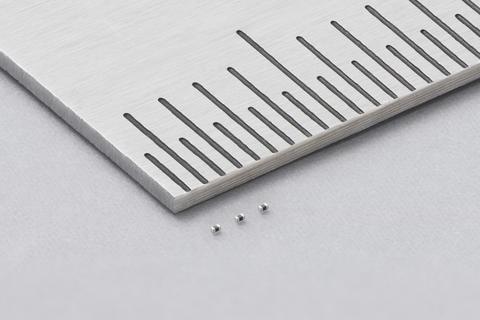
Murata Manufacturing Co. (Tokyo: 6981) has developed what it describes as the world’s smallest negative temperature coefficient (NTC) thermistor, measuring 0.25 mm × 0.125 mm in the 008004-inch size. The NCU01 series is designed for temperature monitoring in space-constrained electronics, including smartphones, wearable devices and advanced semiconductor packages.
Compared with Murata’s previous smallest 01005-inch thermistor, measuring 0.4 mm × 0.2 mm, the new component reduces mounting area by approximately 60% while maintaining equivalent temperature-sensing performance. The series offers resistance tolerance of ±1% and B-constant tolerance of ±1%, according to the company.
Murata plans to begin sample shipments in October 2026, followed by mass production in 2027. The initial lineup will include 100-kilohm and 10-kilohm resistance values, with additional options to be introduced progressively.
Smaller footprint targets precise thermal monitoring
NTC thermistors are temperature-sensitive resistors whose resistance decreases as temperature rises. They are used to monitor temperatures and help electronic systems manage thermal conditions.
As circuit boards and electronic modules become more densely integrated, designers face increasing constraints on component placement. Thermistors positioned farther from heat-generating components may measure temperatures that differ from the actual temperature at the source. Distance can also delay the detection of rapid temperature changes.
The NCU01 series is intended to address these limitations by allowing temperature sensors to be placed closer to critical components without consuming as much board space. This could support more responsive thermal monitoring in compact devices where heat management and component reliability are important.
Potential applications include circuit boards in smartphones and wearable devices, integrated circuit (IC) packages, and system-in-package (SiP) modules, which combine multiple components within a single package.
Manufacturing precision remains a key challenge
Shrinking a thermistor while preserving consistent electrical characteristics presents manufacturing challenges. Resistance and B-constant tolerances are important because variations can affect the relationship between a thermistor’s resistance and the temperature it measures.
Murata said it developed the NCU01 series using its ceramic materials technology, high-precision processing, and refinements to the component structure and manufacturing process. These techniques enable the smaller device to maintain the same stated resistance and B-constant tolerances as its predecessor.
The reduced footprint gives designers greater flexibility when allocating limited space on circuit boards and inside semiconductor modules. Placing sensors closer to heat sources may also help reduce measurement differences and detection delays associated with more distant sensing points, although actual performance will depend on the device’s thermal design and operating conditions.
The development reflects a broader component-design challenge as electronics manufacturers seek to increase functionality within smaller physical footprints. Temperature sensing is one part of that effort, particularly in devices where processors, power components and other heat-generating elements occupy increasingly limited space.
Murata said it will continue expanding its NTC thermistor lineup to support further electronic-device miniaturization and reliability. The company has not disclosed pricing or detailed production-capacity figures for the NCU01 series.