

Samsung Semiconductor India Research (SSIR), the Indian research arm of Samsung Semiconductor, has partnered with the Indian Institute of Science (IISc) to establish a Quantum Technology Lab aimed at advancing research, workforce training and domestic development of quantum technologies.
The collaboration is part of SSIR’s corporate social responsibility commitment. The facility is intended to support dozens of faculty members and hundreds of students each year, including researchers from institutions beyond IISc, particularly in physics, engineering, computer science and mathematics.
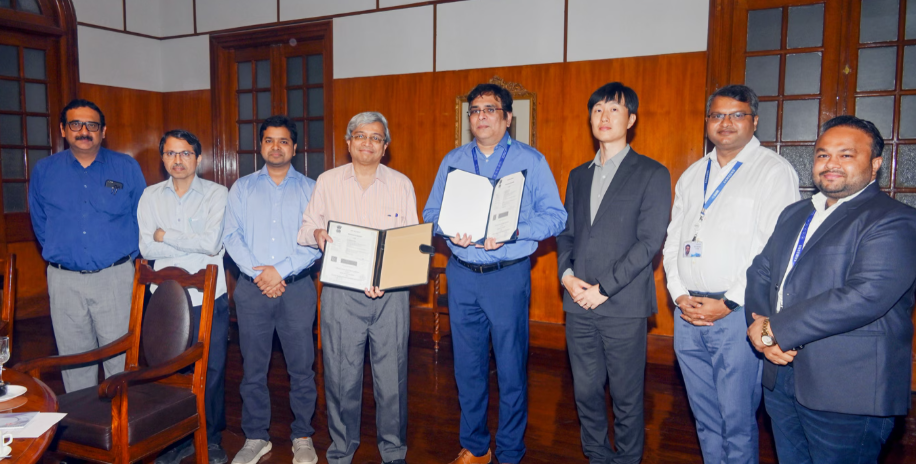
The memorandum of understanding was exchanged between Balajee Sowrirajan, corporate vice president and managing director of SSIR, and Govindan Rangarajan, director of IISc. The lab will be led by Mayank Shrivastava, associate professor in IISc’s Department of Electronic Systems Engineering.
The facility is expected to serve as a center for technological innovation, research training and collaboration with national and international quantum research institutions. Its focus includes developing indigenous quantum technologies and strengthening India’s research capabilities.
Infrastructure for Quantum Research and Training
The lab will integrate cryogenic control chips with qubits, single-photon sources and detectors. It will also address reliability challenges associated with quantum technologies, according to the announcement.
Qubits are the basic units of quantum information. Unlike conventional bits, which represent either zero or one, qubits can exist in combinations of quantum states. Maintaining and controlling these states presents significant engineering challenges, particularly because many quantum systems require extremely low temperatures and precise measurement.
Cryogenic control electronics can help manage quantum devices operating at low temperatures, while single-photon sources and detectors support systems that use individual particles of light. The planned infrastructure is intended to enable interdisciplinary research across these areas.
The announcement did not disclose the lab’s investment, commissioning schedule, equipment suppliers or specific research projects.
Expanding Access to Quantum Technology
The facility is designed to provide students with practical training, research experience and opportunities to develop skills relevant to quantum technologies. Researchers and scientists will gain access to specialized infrastructure and a collaborative environment, while faculty members from other colleges and institutions will be able to access resources for research that may otherwise require substantial capital investment.
The arrangement could help widen access to quantum research facilities beyond institutions with the resources to establish their own specialized laboratories. The scale of that access will depend on the lab’s operating model, capacity and collaboration arrangements, which have not yet been detailed.
“Our partnership with IISc for the establishment of the Quantum Technology Lab is to spearhead breakthroughs in quantum technologies, by empowering skilled workforce, fostering a collaborative innovation, strengthening national competitiveness, and transforming industries with significant societal impact,” Sowrirajan said.
He added that technology scale-up would support India’s efforts to strengthen its position in global quantum innovation.
Rangarajan said the facility would build on IISc’s existing quantum research capabilities and expand opportunities for students and researchers to work on emerging technologies.
Supporting India’s Quantum Technology Ambitions
The partnership comes as India seeks to develop domestic capabilities in quantum computing, communications, sensing and related technologies. Building research infrastructure and training specialists are important steps in moving quantum technologies from laboratory research toward practical applications.
The new lab is intended to encourage industry collaboration, interdisciplinary research and knowledge exchange. However, the partners have not announced measurable research targets, commercialization plans or timelines for specific technological outcomes.