

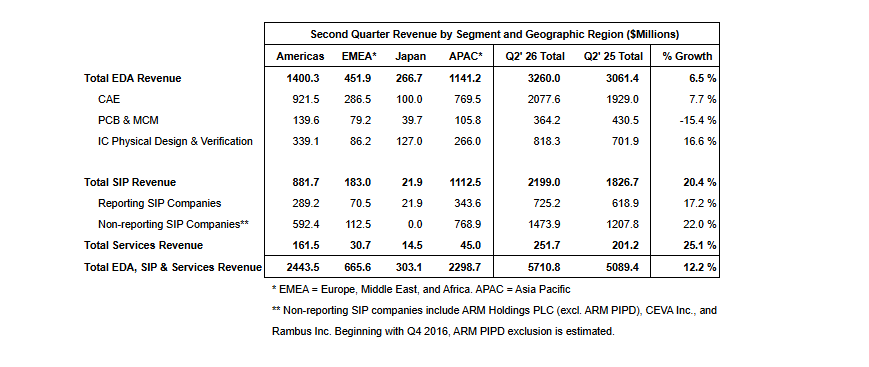
The electronic system design (ESD) industry generated $5.71 billion in revenue in the second quarter of 2026, up 12.2% from $5.09 billion a year earlier, according to the latest Electronic Design Market Data (EDMD) report from the ESD Alliance, a SEMI Technology Coalition.
The four-quarter moving average increased 11.2%, indicating sustained growth across the industry. The report covers electronic design automation (EDA), semiconductor intellectual property (SIP), printed circuit board and multi-chip module design, and related services.
Walden C. Rhines, executive sponsor of the SEMI Electronic Design Market Data report and CEO of Silvaco Group, said all product categories except printed circuit board and multi-chip module design recorded year-over-year revenue gains. IC physical design and verification, semiconductor IP and services posted double-digit growth, while every geographic region reported an increase.
Asia-Pacific (APAC) led regional growth, with revenue rising 22.4% year over year to $2.30 billion.
Semiconductor IP and services lead segment growth
Semiconductor intellectual property was the largest product and application category in the report, generating $2.20 billion in Q2 2026, an increase of 20.4% from the same quarter last year. Its four-quarter moving average rose 16.6%.
The category includes reusable semiconductor design blocks that chip developers can license and integrate into their own designs. Revenue from companies reporting SIP figures increased 17.2% to $725.2 million. Revenue attributed to non-reporting SIP companies, including Arm Holdings, CEVA and Rambus, rose 22% to approximately $1.47 billion.
Services recorded the fastest year-over-year growth among the reported categories, increasing 25.1% to $251.7 million. Its four-quarter moving average advanced 15.2%.
IC physical design and verification revenue rose 16.6% to $818.3 million. However, its four-quarter moving average increased 5.4%, a slower pace than the quarterly year-over-year gain.
Computer-aided engineering (CAE), which includes software used to simulate and analyze electronic systems, generated $2.08 billion, up 7.7%. Its four-quarter moving average rose 10.7%.
Printed circuit board and multi-chip module design was the only category to contract. Revenue fell 15.4% to $364.2 million, while its four-quarter moving average declined 1.3%.
Asia-Pacific drives regional expansion
The Americas remained the largest regional market, generating $2.44 billion in revenue, up 7.1% year over year. The region’s four-quarter moving average increased 8.6%.
APAC recorded the strongest growth, with revenue reaching $2.30 billion, up 22.4%. Its four-quarter moving average rose 18.3%, suggesting that growth extended beyond the latest quarter.
Europe, the Middle East and Africa (EMEA) generated $665.6 million, an increase of 2.3%. Its four-quarter moving average grew 8.6%.
Japan’s revenue increased 9.3% to $303.1 million. However, its four-quarter moving average declined 8.2%, contrasting with the region’s latest quarterly performance.
The regional figures measure procurement of electronic system design products and services rather than revenue generated exclusively by companies headquartered in each region.
Industry headcount declines despite revenue growth
The companies tracked by the EDMD report employed 71,396 people worldwide in Q2 2026, down 1.6% from 72,529 in the second quarter of 2025.
The decline in reported employment alongside double-digit industry revenue growth points to different trends in revenue and workforce levels. The report does not establish the reasons behind the headcount reduction.