

Teradyne Robotics, a division of Teradyne Inc. (NASDAQ: TER), has partnered with robotics AI company Sereact to expand the deployment of physical AI across retail, logistics and manufacturing, combining Sereact’s AI platform with collaborative robots from Universal Robots.
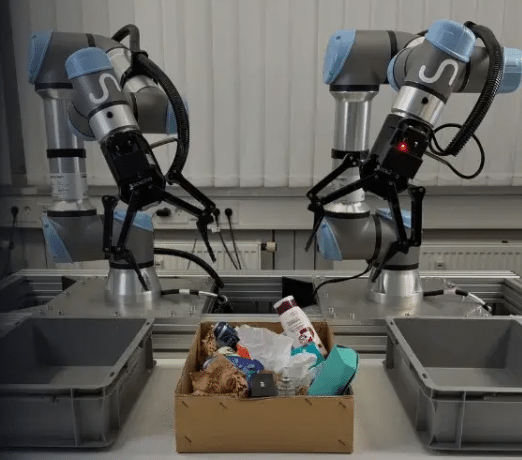
The companies said their joint solutions are already operating at customer sites across Europe, with hundreds of Universal Robots arms shipped in dual-arm configurations. The systems are designed to automate tasks involving varied products, unfamiliar items and inconsistent packaging, which have traditionally been difficult for conventional automation to handle reliably.
The partnership formalizes collaboration between the companies as demand grows for AI-enabled automation in warehouses and manufacturing facilities. Sereact’s Cortex platform controls Universal Robots arms to perform tasks such as processing returned goods, picking individual items and replenishing store inventory.
Physical AI Moves Into Live Logistics Operations
A key application is fashion returns processing, where products arrive in different shapes, orientations and packaging. Conventional automated systems often depend on predictable item presentation and predefined workflows, making variable goods more challenging to handle.
Sereact’s Cortex uses a vision-language-action (VLA) model to interpret visual information and guide robot actions. The platform is designed to generalize across different items and tasks, reducing the need to create separate workflows for every product type.
“Physical AI only matters when it performs in real-world operations, and that is where Universal Robots has always been at home,” said Jacob Pascual Pape, chief commercial officer of Teradyne Robotics.
Pape said the combined system can handle mixed goods and unfamiliar items, adding that deployments have progressed beyond demonstrations and pilot projects to active customer operations.
The companies have deployed the technology at fulfillment centers operated by CEVA Logistics for Zalando SE (Xetra: ZAL), the European fashion and lifestyle platform. At facilities in Greven, Germany, and Świebodzin, Poland, the robots autonomously process returned fashion products.
The deployments represent the first phase of a broader initiative to expand returns automation across Europe.
Automating returns can help retailers prepare products for resale more quickly, potentially reducing manual handling and the time goods spend outside the available inventory. The companies also said the technology can support compliance with European Union rules restricting the destruction or landfill disposal of returned merchandise.
One AI Model Across Multiple Tasks
Beyond returns processing, the joint offering targets store replenishment, piece-picking, sortation, order induction, machine tending, bin consolidation, kitting, packing and general goods handling.
Sereact says Cortex can support multiple applications through a common production model rather than requiring retraining for every new item or task. The approach is intended to allow improvements made through one robot’s operation to benefit other systems using the same platform.
“Partnering with Teradyne Robotics and its global distribution and integrator network helps us bring that one brain to their customers around the world,” said Dr. Ralf Gulde, Sereact’s CEO and co-founder.
The partnership combines Sereact’s AI software with Universal Robots’ collaborative robot hardware and Teradyne Robotics’ distribution and integration network. Universal Robots, alongside Mobile Industrial Robots, forms part of Teradyne Robotics’ portfolio.
Sereact has also opened a US headquarters in Boston, Massachusetts, to support expansion into North America and address demand for its joint solutions.
NVIDIA Technology Supports Training and Deployment
The companies are demonstrating the technology at NVIDIA GTC Berlin 2026, where Cortex controls two Universal Robots UR12e-1300 arms in a returns-handling demonstration.
NVIDIA Corp. (NASDAQ: NVDA) provides computing and simulation technologies used throughout the system’s development and deployment process.
Cortex is trained using NVIDIA Isaac Sim, an open simulation framework, alongside NVIDIA Cosmos world models. The model is then post-trained through reinforcement learning with NVIDIA Isaac Lab and benchmarked on Teradyne Robotics hardware before deployment.
At operating sites, Cortex runs on NVIDIA Jetson Thor, which handles inference at the robotic cell. NVIDIA DGX Spark supports site-level development, validation and model updates.
This combination allows developers to train and test robot behaviour in simulation before deploying models on physical equipment. Benchmarking on the target hardware provides an additional step before operational use.
Teradyne Robotics also uses NVIDIA computing across its Universal Robots and Mobile Industrial Robots product ranges. The company is contributing SimReady OpenUSD robot assets for both product lines to NVIDIA’s SimReady Central Library on Hugging Face, allowing developers to access and reuse digital robot models in simulation with less asset preparation.
Scaling Beyond Demonstrations
The partnership reflects a broader effort across industrial automation to combine adaptable AI software with established robotic hardware. The commercial challenge is making these systems reliable across changing inventory, packaging and operating conditions while maintaining the speed required in production environments.
Existing deployments at Zalando fulfillment centers provide an operational example, although the companies have not disclosed specific productivity gains, processing rates or financial returns from the systems.
Teradyne Robotics and Sereact plan to use their partnership and distribution network to expand physical AI applications across retail, logistics and manufacturing. The scale of adoption will depend on how effectively the systems perform across different workflows and customer environments.