

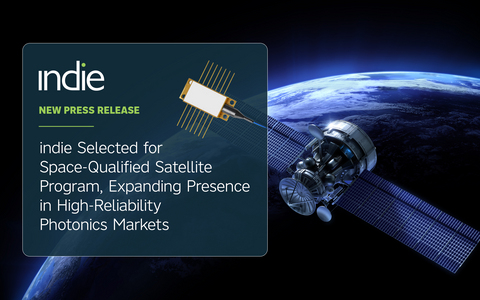
indie Semiconductor (Nasdaq: INDI) has secured a place in Europe’s Copernicus Hyperspectral Imaging Mission for the Environment (CHIME), with its superluminescent light-emitting diodes (SLEDs) completing final space qualification testing for use aboard the mission’s satellites.
The selection expands the company’s presence in space-qualified photonics, a market that demands stringent reliability and performance standards. The company is also seeking to extend its photonics business into high-reliability applications beyond its automotive-focused operations.
CHIME is part of Copernicus, the European Union’s Earth observation program. The mission will use hyperspectral imaging to collect detailed information about the planet, supporting environmental monitoring and analysis.
indie’s broadband SLEDs operate at a wavelength of 1550 nanometers and will act as stable optical reference sources for calibrating CHIME’s hyperspectral imaging instruments. Consistent calibration is essential to maintaining the accuracy and comparability of environmental measurements throughout a satellite’s operational life.
The satellites carrying the devices are currently scheduled to launch in 2028 and 2030. The company did not disclose the value of the program or the number of components selected.
Photonics Applications Extend Beyond Earth Observation
The selected SLED platform combines high optical power, broad spectral output and long-term stability. These characteristics support precision sensing and instrumentation in environments where component performance must remain consistent over extended periods.
The devices also have applications in fiber optic gyroscopes (FOGs), which use optical measurements to determine orientation and support navigation, guidance and stabilization. FOG-based systems are used in aerospace and defense platforms, including aircraft, helicopters, unmanned aerial vehicles, drones and space systems.
Qualification for CHIME adds to indie Photonics’ work in space programs and provides another application for its optical components in systems with demanding operating requirements.
For semiconductor suppliers, space programs can offer opportunities beyond high-volume commercial markets, although qualification requirements and long development cycles can make these projects technically demanding. The CHIME selection gives indie a foothold in an Earth observation mission while complementing its existing photonics applications.
“Being selected for CHIME is a proud moment for our Photonics team and a strong endorsement of our SLED technology,” said Philipp Vorreau, vice president and general manager of the SLEDs Photonics Division at indie Semiconductor.
Vorreau said the selection reflects the team’s engineering work and the reliability required for space applications. He added that the company sees opportunities in space and other markets where optical performance and quality are critical.
The mission’s planned launches in 2028 and 2030 will mark the next stage in deploying the qualified components. The selection also supports indie’s effort to broaden its photonics business into specialized markets where stability and reliability are central to system performance.