

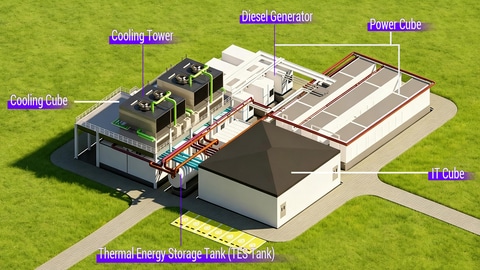
KAYTUS has introduced a fully prefabricated, liquid-cooled data center platform designed for large-scale artificial intelligence (AI) infrastructure, as demand for high-density computing continues to reshape data center construction and operations.
The solution, unveiled at the International Supercomputing Conference (ISC) 2026, adopts a modular architecture that standardizes AI data centers into three factory-built units covering IT infrastructure, power systems and cooling. The company said the platform can be deployed as a 3MW base module and expanded incrementally to 10MW, 15MW, 100MW and eventually gigawatt-scale AI factory installations.
The announcement comes as governments and enterprises accelerate investments in sovereign AI infrastructure, particularly across Europe, where operators are seeking to deploy high-performance computing capacity more quickly while managing rising construction costs and increasing power densities associated with next-generation graphics processing units (GPUs).
According to KAYTUS, conventional data center construction typically requires 18 to 24 months, with electrical, mechanical and cooling systems often supplied by multiple vendors. The fragmented approach can extend deployment timelines, complicate project coordination and increase commissioning risks.
The company said its prefabricated model shifts much of the integration process from construction sites to manufacturing facilities, allowing complete IT, electrical and cooling systems to be assembled, tested and validated before shipment.
Unlike modular approaches that primarily package server racks or cooling equipment, KAYTUS said its platform integrates the complete facility into three standardized modules known as the IT Cube, Power Cube and Cooling Cube.
The IT Cube houses liquid-cooled compute infrastructure in a two-level container design separating computing equipment from power and networking cabling. A standard 3MW deployment accommodates 18 liquid-cooled compute racks, networking, storage and management systems while supporting rack power densities of up to 150kW, with future upgrades to more than 200kW planned for next-generation AI accelerators.
The company said factory integration includes liquid-cooling distribution systems, leak detection, thermal management and network architecture, reducing the amount of assembly required after delivery.
Power infrastructure is housed within the Power Cube, which combines transformers, switchgear, uninterruptible power supply (UPS) systems and automatic transfer equipment inside prefabricated enclosures. Diesel generator units are assembled and tested before shipment to support continuous operations in the event of grid interruptions.
KAYTUS said the architecture is designed to meet Tier III-level N+1 availability requirements through redundant power systems intended to eliminate single points of failure. Battery systems provide temporary backup while generators assume electrical load during outages.
Cooling infrastructure is integrated into a separate Cooling Cube that combines liquid-cooling equipment with air-cooled chillers and closed-loop cooling towers. The system includes redundant pumps, pressure management and water treatment equipment, while thermal storage provides temporary cooling during power transitions. An emergency water reserve is designed to maintain cooling for up to 72 hours in the event of supply disruptions.
The company said all modules undergo pressure testing, failover validation and system commissioning before leaving the factory, reducing installation complexity at deployment sites.
KAYTUS said the approach addresses three key challenges facing AI infrastructure projects: lengthy construction schedules, inconsistent build quality resulting from regional labour shortages, and the financial risks associated with committing capital to large facilities before computing demand materialises.
By standardising infrastructure into repeatable modules, operators can expand capacity in stages rather than building large campuses upfront. The architecture allows installations to begin with a 3MW deployment before scaling to larger facilities without requiring significant modifications to existing power or cooling infrastructure.
The company estimates deployment timelines can be reduced to approximately six to eight months, including design, factory manufacturing, transportation and on-site commissioning, compared with conventional construction cycles of up to two years. A standard 3MW module can be commissioned within about one month after delivery.
KAYTUS also said it will provide end-to-end project delivery under a single contract, covering site assessment, engineering design, manufacturing, logistics, installation, commissioning and operational support. The company said a single-vendor approach is intended to simplify project management and reduce integration risks across complex AI infrastructure deployments.
The launch reflects a broader shift within the data center industry as AI workloads drive demand for higher rack densities, liquid cooling technologies and faster deployment models. Operators are increasingly looking for modular infrastructure that can be expanded as computing requirements evolve, while governments are investing in domestic AI capacity to support research, industry and digital sovereignty.