

PolyJoule, Inc., a Boston-based MIT spinout and developer of conductive polymer battery technology, has unveiled its third-generation energy storage chemistry designed with self-extinguishing capability. The development marks a further push by the company into safer, simplified stationary energy storage systems for grid, commercial, and residential applications.
The new chemistry is built on a proprietary conductive polymer cathode paired with a liquid salt electrolyte. According to the company, the architecture is designed to address three persistent challenges associated with lithium-ion batteries: safety risks, system complexity, and dependence on foreign supply chains for critical materials.
Unlike conventional battery technologies such as lithium-ion, lead-acid, nickel, and emerging sodium-ion systems, PolyJoule replaces metal-based charge storage with an organic polymer backbone. In this structure, charge is stored along the polymer chain rather than within a crystalline metal lattice. The company said this shift reduces dendrite formation, improves cycle life, and enhances operational safety across stationary energy storage use cases.
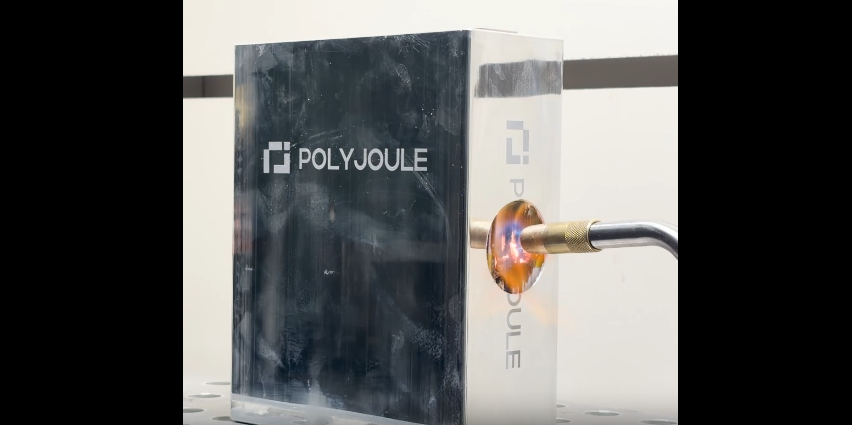
A defining feature of the third-generation platform is its self-extinguishing behavior under extreme thermal stress. In a controlled demonstration, a full-size cell was exposed to a propane blowtorch generating temperatures of approximately 3,600°F (1,982°C). The company reported that the cell sustained exposure but self-extinguished immediately once the external flame source was removed.
“PolyJoule has always been at the forefront of energy storage safety,” said Eli Paster, co-founder and chief executive officer of PolyJoule. “We were the first company in the world to prove through UL 9540A testing that our conductive polymer cells do not go into thermal runaway. Our guiding principle is simple: batteries should not start fires, should not spread fires, and should not catch fire.”
The company said its technology eliminates the need for active thermal management systems, which are commonly required in lithium-ion deployments. This reduction in system complexity is expected to simplify installation, operation, and long-term maintenance of energy storage systems.
PolyJoule also claims significant performance improvements in its latest generation. The company reports a 10x increase in energy density compared to its first-generation systems, while maintaining more than 10,000 charge cycles. It positions this combination as suitable for long-duration energy storage applications where durability and safety are critical.
“Materials that have a propensity to catch fire often contain reactive metals that spontaneously react with air and volatile liquids,” said Timothy Swager, John D. MacArthur Professor of Chemistry at the Massachusetts Institute of Technology and co-founder of PolyJoule. “The advantage of PolyJoule’s batteries is that they have neither. They use non-flammable conducting polymers and a liquid salt electrolyte with a vapor pressure a billion times lower than that of lithium-ion electrolytes.”
Swager added that the system is designed for safe deployment in residential and commercial environments, where safety standards are increasingly stringent as distributed energy adoption grows.
Headquartered in Boston, Massachusetts, PolyJoule also emphasizes a domestic, rare-earth-free supply chain strategy. The company said this approach is intended to reduce procurement complexity and improve resilience in energy storage deployment at scale.
The third-generation chemistry is part of PolyJoule’s broader strategy to expand into markets where safety is a non-negotiable requirement. These include grid infrastructure, commercial power systems, and residential energy storage tied to renewable energy integration.
PolyJoule said it will begin accepting applications from qualified solar, battery, and generator installers in select markets later this year. The company is targeting deployment across commercial, industrial, and residential segments as it moves toward broader commercialization of its conductive polymer platform.