

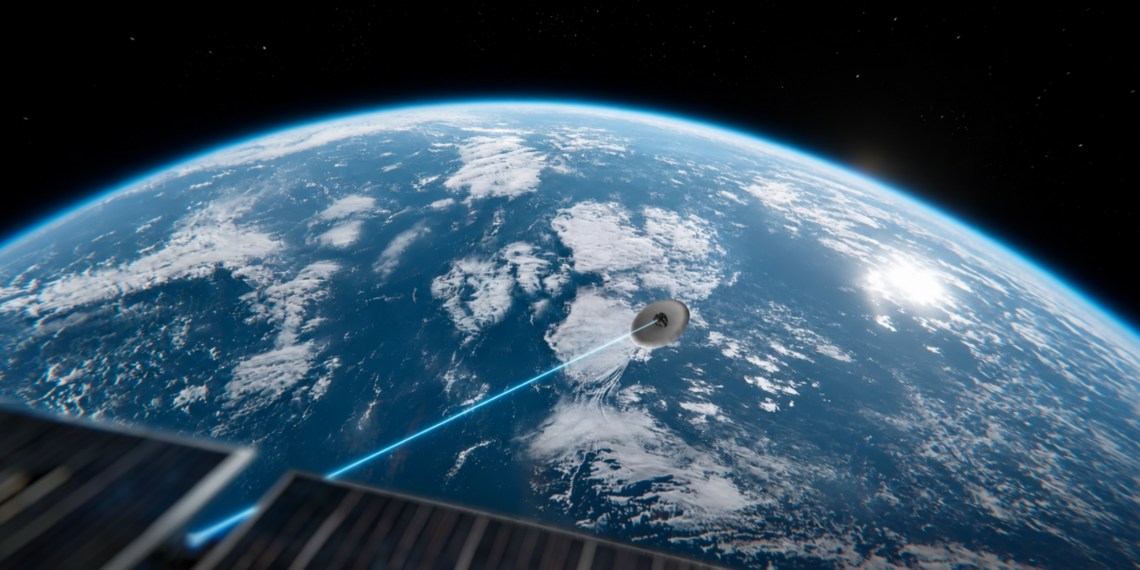
Lithuanian space and defence company Astrolight and European space logistics firm ATMOS Space Cargo have signed a memorandum of understanding to demonstrate what they say could be the first in-flight optical communications link between a re-entry spacecraft and an orbiting satellite.
The demonstration is planned for 2027 and will use Astrolight’s ATLAS-X laser communication terminals aboard ATMOS’ PHOENIX re-entry vehicle and a satellite participating in the test. The companies aim to establish a spacecraft-to-satellite optical link capable of transferring mission and system data at rates of up to 2.5 Gbps during orbital operations and atmospheric re-entry.
The partnership targets a communications gap that becomes particularly important as commercial cargo-return missions become more frequent. Spacecraft returning scientific samples, manufactured products and other high-value payloads need reliable telemetry throughout the mission, including the period when they pass through the atmosphere.
Conventional radio-frequency communications can become degraded during re-entry, limiting the amount of information available to operators at a critical stage of the mission. The companies said a continuous optical connection could provide real-time information on vehicle health, guidance, de-orbit performance and payload conditions before the spacecraft reaches the ground.
For ATMOS, such connectivity is part of the broader architecture of its PHOENIX return system. The company is developing the vehicle to support more autonomous cargo-return operations as Europe seeks greater control over access to and from low Earth orbit.
Laser communications use narrow, focused beams to transmit data at substantially higher rates than conventional radio-frequency systems. The technology can also be more difficult to intercept, detect or jam, making it relevant to both commercial space operations and defence applications.
“Testing a laser link between PHOENIX and an orbiting satellite will mark an important first for re-entry communications,” said Laurynas Mačiulis, CEO of Astrolight. He said the longer-term objective is to enable re-entry vehicles to communicate directly with satellites and eventually satellite constellations, giving operators access to more mission data in real time.
Astrolight’s ATLAS-X terminal has been designed as a compact optical communications system with low size, weight and power requirements. That is particularly relevant for re-entry vehicles, where available mass, power and internal space must be divided among payloads, propulsion, guidance and other mission-critical systems.
ATMOS CEO Sebastian Klaus said real-time connectivity would become increasingly important as cargo-return missions become more autonomous and data-intensive. The company sees the laser link as a potential layer for payload monitoring, autonomous de-orbit operations and re-entry management.
The planned demonstration comes as Europe seeks to develop independent commercial cargo-return capabilities. European missions currently depend heavily on international partners for transporting cargo to and from low Earth orbit. The European Space Agency’s LEO Cargo Return Services Initiative is among the efforts aimed at building European capacity and reducing that dependence.
For the emerging space-return market, the ability to maintain high-speed communications throughout re-entry could have implications beyond telemetry. Continuous access to vehicle and payload data could support faster operational decisions, improve monitoring of high-value cargo and provide additional information for autonomous mission management.
The 2027 demonstration will therefore test more than a new communications connection. It will assess whether optical links can remain practical as a spacecraft transitions from orbital flight into atmospheric re-entry, one of the most demanding phases for space communications.
If successful, Astrolight and ATMOS expect the technology to support future cargo-return missions and potentially connect re-entry vehicles with wider satellite networks, creating a communications infrastructure for more routine and scalable space-return operations.