

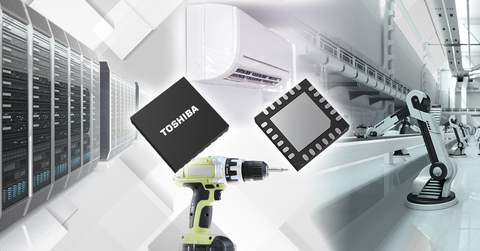
Toshiba Electronic Devices & Storage Corporation has launched an 80V-rated electronic fuse IC aimed at protecting 48V power lines in industrial equipment, as higher-voltage power architectures gain traction across servers, network equipment, factory automation systems and robots.
The company said shipments of the new TCKE1401NM began August 20. The device expands Toshiba’s portfolio of eFuse ICs, which combine multiple power-line protection functions in a single semiconductor component.
The launch comes as manufacturers adopt 48V systems to support higher output power and improve energy efficiency. The shift is increasing demand for protection circuits capable of handling higher voltages while responding to a wider range of electrical faults.
Toshiba said the TCKE1401NM supports operating voltages from 4.7V to 75V and carries an 80V rating, allowing it to be used in 24V, 48V and 54V systems. Its typical on-resistance of 44.5mΩ is designed to reduce power losses during operation.
The device is housed in a 4.0mm × 4.0mm VQFN24D package, which Toshiba describes as an industry-leading compact package for 80V-rated eFuse ICs. The smaller footprint is intended to help equipment manufacturers reduce PCB size while integrating more protection functionality.
An eFuse differs from a conventional physical fuse by combining current protection with electronic monitoring and control functions. The TCKE1401NM incorporates overcurrent protection, overvoltage protection, reverse-current blocking, reverse-polarity protection and thermal shutdown.
During an overcurrent event, its current-limiting function controls output current. The device can also shut down the output when an overvoltage condition is detected. External resistors allow designers to configure the operating thresholds for both functions.
The IC supports true reverse-current blocking and reverse-connection protection using external MOSFETs, providing protection for the device and downstream circuits. It also includes a FLAG function that can notify external circuitry of abnormal conditions, along with a power-good function for monitoring output voltage and an output-current monitor.
Thermal shutdown is designed to turn off the device when an unexpected short circuit or excessive heat generation occurs. Designers can choose between auto-retry and latch-off recovery modes depending on the application. In auto-retry mode, the device attempts to resume operation automatically, while latch-off requires an external signal to restart the circuit.