

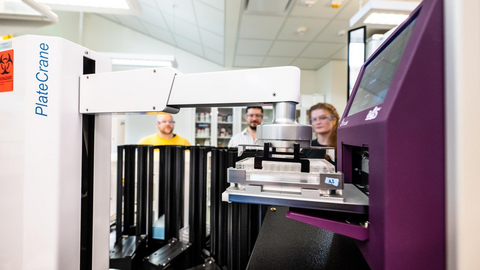
Argonne National Laboratory is developing learning-based robotic systems designed to assist scientists in laboratory environments. The project aims to create robots capable of adapting to complex research tasks and working alongside human researchers in real-world labs.
The initiative, called RoSA: Robot Scientific Assistant for Accelerating Experimental Workflows, is part of the United States Department of Energy’s Genesis Mission. The broader program focuses on accelerating scientific productivity through artificial intelligence, quantum computing, and advanced computing technologies.
Researchers involved in the project are building systems that allow robots to learn directly from scientists. The process begins by equipping researchers with sensors while they perform laboratory procedures. Motion data and workflow patterns are then captured and used to train AI models.
The goal is to help robots understand how scientific tasks are performed and adapt to changing laboratory conditions.
Nicola Ferrier said robots with advanced motor skills already exist, but safely deploying them in research laboratories remains difficult. She said the RoSA project focuses on teaching robots by observing experienced scientists during hands-on experimental work.
Ferrier specializes in computer vision systems used to guide robots and automated machinery. She is working alongside Arvind Ramanathan, whose research includes self-driving laboratories and AI systems for scientific decision-making.
According to Argonne researchers, the project is intended to strengthen the underlying robotics and computing technologies required for large-scale automated laboratory systems. The researchers believe such systems could improve the speed, consistency, and reliability of scientific experiments.
The RoSA initiative is also linked to broader DOE-supported automation efforts, including the Orchestrated Platform for Autonomous Laboratories (OPAL). The OPAL project is focused on creating networks of autonomous laboratories capable of accelerating discoveries in biology, biotechnology, and energy science.
Ramanathan said advanced robotics systems being developed for OPAL are expected to support biological experiments and AI-driven laboratory workflows.
As part of the project, researchers will classify laboratory tasks based on complexity and precision requirements. The team will then evaluate which robotic systems are best suited for different activities. These include fixed-station robots, humanoid robots, and hybrid robotic systems that combine mobility with precision handling capabilities.
The systems will first be tested in virtual laboratory environments before being introduced into real-world scientific settings.
Ferrier said the research team aims to achieve a fivefold improvement in task efficiency within the next year. Long-term plans include developing robotic scientific assistants capable of integrating with existing laboratory equipment to improve safety, reduce manual workloads, and accelerate scientific discovery.
The project is funded through the DOE Office of Science’s Advanced Scientific Computing Research program.