


Maglut Heavy Industries has emerged from stealth with a chromatography-based technology aimed at rebuilding U.S. capacity to separate and process rare earth elements, as Washington seeks to reduce dependence on China for minerals critical to defense, semiconductors and energy infrastructure.
The Long Beach, California-based company is developing a water-based processing platform designed to separate individual rare earth elements without relying on the solvent extraction methods that have traditionally dominated the industry.
Rare earth elements are used across permanent magnets, semiconductor-related technologies, energy systems, defense equipment and other advanced manufacturing applications. Despite their strategic importance, the United States has limited domestic capacity for separating and refining these materials, leaving manufacturers exposed to concentrated global supply chains.
Maglut said its technology draws on chromatography, a separation technique that has been refined for decades by the biotechnology industry to purify biological products. The company is adapting the approach for mineral processing and says it could offer a lower-energy alternative to conventional solvent extraction.
“Rare earth processing is one of the clearest examples of a sovereign capability America let atrophy,” Curtis Wu, co-founder and CEO of Maglut, said in a statement. He said the company aims to rebuild domestic manufacturing capacity by changing how rare earth materials are processed.
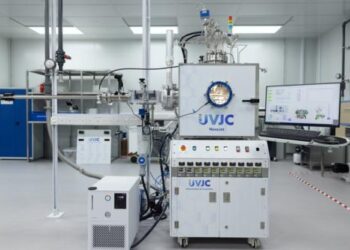
The company is marking its launch with an invitation-only event at its Long Beach headquarters, where it is showcasing ARC-1, its separation system.
Maglut said ARC-1 has been validated at pilot scale using real-world feedstock. According to the company, the process has separated feedstock into individual rare earth oxides with purity levels of 99.9% or higher.
A key part of Maglut’s strategy is vertical integration. The company says it designs and manufactures its own chromatography resin technology, allowing it to control both the separation platform and the materials used in the process.
The emergence of the company comes as the U.S. government and defense industry place greater emphasis on securing domestic supplies of critical minerals. New Department of War rules scheduled to take effect in January 2027 will require defense contractors to eliminate China from their rare earth magnet supply chains, according to Maglut.
That policy shift is expected to increase demand for alternative sources and processing capacity outside China. The challenge for new entrants will be producing rare earth materials at competitive costs while establishing reliable commercial-scale operations.
Maglut argues that improvements in chromatography technology, combined with higher rare earth prices, have created conditions for the processing method to become commercially viable in critical minerals.
The company was founded by MIT graduate Curtis Wu and Azhar Yerzhanova. Its broader objective is to establish a domestic processing platform that can support U.S. manufacturers seeking more secure access to refined rare earth materials.
For the U.S. rare earth industry, the technology addresses a particularly important bottleneck. Mining ore is only one part of the supply chain; separating individual rare earth elements into usable, high-purity materials is technically complex and has historically been concentrated in a small number of countries.
Maglut’s next challenge will be demonstrating that its pilot-scale results can translate into consistent commercial production. If successful, its chromatography platform could provide another route for expanding domestic rare earth processing capacity at a time when supply-chain security has become a strategic priority for the U.S. technology and defense sectors.