

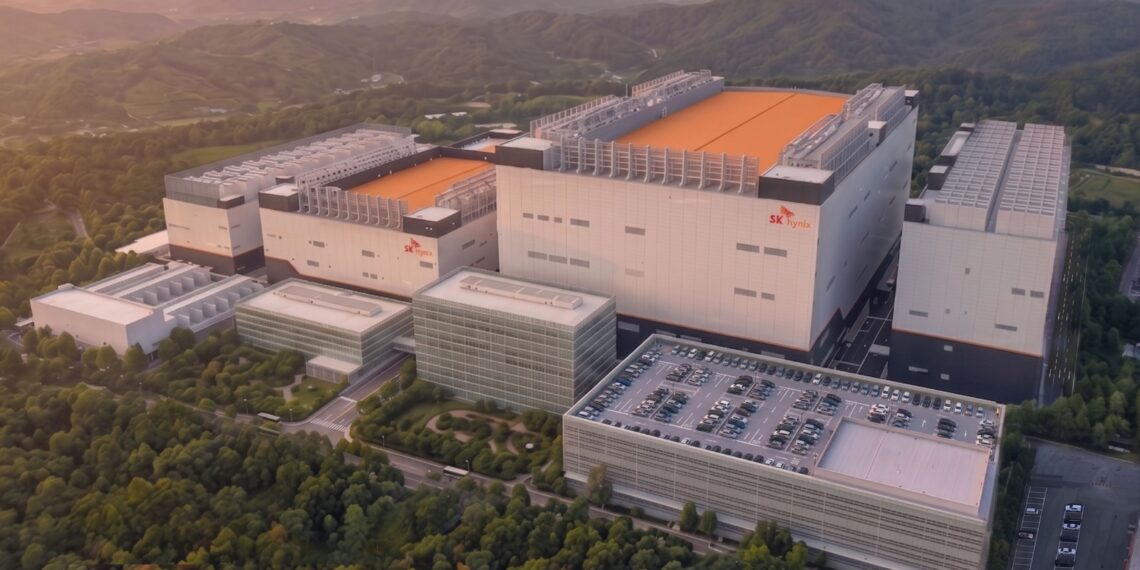
SK hynix Inc. (KRX: 000660) is committing about KRW 54 trillion to two new semiconductor fabs in South Korea, stepping up investment in production capacity as artificial intelligence reshapes demand for memory chips.
The company’s board has approved KRW 35.2 trillion for the Y2 fab at the Yongin Semiconductor Cluster and KRW 19.1 trillion for the M17 fab at its Cheongju campus. The decision marks the next stage of SK hynix’s long-term manufacturing expansion and comes as demand for high-bandwidth memory (HBM), advanced DRAM and enterprise storage accelerates alongside AI infrastructure investment.
SK hynix said the investment is based on its assessment that the current growth in memory demand represents a structural shift rather than a conventional industry cycle. Citing Omdia forecasts, the company said both DRAM and NAND demand are expected to grow at a compound annual rate of 19% from last year through 2030.
The scale and timing of the investment underline the strategic importance of supply in the AI memory market. As AI models become larger and computing workloads more demanding, memory capacity and bandwidth have become increasingly important constraints on system performance. For chipmakers, the ability to bring capacity online when customers need it has become as important as developing the underlying technology.
The Y2 facility will be the second of four fabs planned for the Yongin Semiconductor Cluster. Covering about 1.13 million square metres, the fab will serve as a DRAM production base for HBM and other next-generation memory products.
Construction is scheduled to begin in July 2027, with the first cleanroom targeted for June 2029. The investment programme is expected to run through October 2031. SK hynix is simultaneously progressing with Y1, whose first cleanroom is targeted to open in February 2027.
The company has brought forward the planned completion of the four-fab Yongin cluster to 2033 from the original 2045 target. Y2 is the second phase of that accelerated development plan.
The KRW 35.2 trillion allocation also covers supporting infrastructure, including a business support building and an integrated research and development centre intended to bring product testing, analysis and experimentation together. Power and water infrastructure required for operations through Y2 is already about 99% complete, allowing fab construction and supporting infrastructure work to progress in parallel.
The second investment will expand NAND manufacturing at Cheongju. The M17 fab will cover approximately 680,000 square metres and is scheduled to break ground in February 2027, with its first cleanroom expected to open in December 2028. The investment period is planned to continue through April 2031.
Cheongju was selected partly for its existing semiconductor infrastructure. SK hynix already operates the M11, M12 and M15 fabs at the campus, giving the company access to established power and water systems and an operating ecosystem that can support a faster construction timeline.
The expansion comes as NAND demand increasingly shifts towards enterprise applications. The rapid deployment of AI services is driving demand for enterprise solid-state drives, while storage requirements for AI inference workloads, including key-value cache, are creating another source of growth. SK hynix expects demand to broaden further as agentic and physical AI applications move into wider deployment.
The company is taking a phased approach to converting the new physical capacity into actual production. While fab construction will follow the master schedule, cleanroom expansion and equipment installation will be carried out sequentially according to customer demand and market conditions.
That approach is designed to give SK hynix access to capacity without committing the full capital outlay for equipment before demand is established. It also gives the company flexibility to adjust production deployment as the AI memory market evolves.
The investment comes as South Korea seeks to strengthen its position in the global semiconductor supply chain. SK hynix expects the Yongin and Cheongju projects to generate additional opportunities for equipment and materials suppliers, create jobs and support economic activity around the manufacturing sites.
For SK hynix, the immediate objective is capacity. The broader strategic goal is to ensure that its production footprint keeps pace with an AI market in which memory has moved closer to the centre of the computing architecture.
“This investment is a decision made to seize opportunities in line with the market’s growth speed,” an SK hynix official said. “By proactively securing production capabilities, we aim to establish ourselves as a key partner in AI infrastructure, contributing to the stability of the global AI semiconductor supply chain.”