

Finnish startup S-Transistors has raised €2.6 million in pre-seed funding to commercialize a new class of superconducting transistors designed to address the growing power, wiring and scalability challenges involved in controlling large-scale quantum computers.
The company, which originated from VTT Technical Research Centre of Finland, is developing integrated circuits that combine transistor functionality with the extremely low power dissipation of superconducting devices. Its immediate focus is cryogenic signal control for quantum systems, while its longer-term ambition is to develop a quantum motherboard capable of operating alongside quantum processors at millikelvin temperatures.
The funding round was led by Nordic venture capital firm Lifeline Ventures and included an angel investor. S-Transistors said it will use the capital to develop prototypes for cryogenic signal control and handling, establish its own cryogenic laboratory, set up a pilot manufacturing line for its superconducting integrated circuits and expand its team.
The company is entering a quantum computing market in which hardware developers are confronting a problem that is becoming more difficult as processor architectures grow. Superconducting quantum computers require extremely low temperatures to preserve the quantum states used to perform calculations. Yet much of the electronics responsible for controlling and reading those processors operates at significantly higher temperatures.
Signals between the quantum processing unit, or QPU, and room-temperature control systems are typically carried through extensive wiring into the cryostat. As quantum processors add more qubits, the number of required connections can increase substantially, creating challenges in terms of physical space, signal management, power consumption and cooling.
The issue becomes particularly important as the industry pursues systems containing hundreds of thousands of qubits. Conventional approaches that rely on dedicated wiring and room-temperature electronics could become increasingly difficult to scale, according to S-Transistors.
“Today’s efforts in scaling cryogenic quantum computers have delivered tremendous progress, with several practical use cases already demonstrated,” said Heorhii Bohuslavskyi, co-founder and CEO of S-Transistors. “However, further scaling is approaching a hard wall, as it still relies on power-hungry room-temperature electronics and separate wiring for each quantum bit.”
One potential solution is to move more of the control electronics into the cryogenic environment, placing them closer to the quantum processor. That could reduce the distance signals need to travel and potentially simplify system architecture. But conventional electronics present a major obstacle because the heat they generate can place significant demands on the cooling infrastructure and disturb the environment required by the quantum processor.
S-Transistors is betting on superconducting transistors to address that trade-off. The company says its technology combines the switching and computational capabilities associated with transistors with the near-zero power dissipation of superconducting devices. The resulting circuits are intended to operate close to the quantum processor without imposing the same thermal burden as conventional electronics.
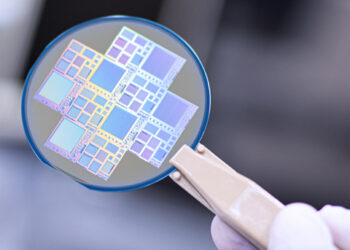
The company says its superconducting transistor technology has already been demonstrated at wafer scale, an important milestone for a technology that ultimately needs to move beyond laboratory research into repeatable manufacturing.
“When you think about it, the transistor is the most mass-manufactured device in human history,” said Andrey Generalov, co-founder and CTO of S-Transistors. “By combining the transistor functionality, with its unparalleled computing potential, and the superconducting property of near-zero power dissipation in a single device, we can reach a completely new level of energy-efficient cryogenic computing.”
S-Transistors plans to take a more incremental route to commercialization. Its first product is a superconducting-transistor-based multiplexer designed to plug into existing cryogenic setups. The device is intended to provide signal routing capabilities for quantum hardware developers and accelerate prototyping without requiring an entirely new quantum computing architecture.
The company expects to ship the multiplexer to early customers and strategic partners within its first year. It views the product as an initial application of its technology and a step toward a more ambitious platform.
That platform is the proposed quantum motherboard, which would bring classical control and interface electronics directly alongside a quantum processor inside the cryogenic environment. Such a system could potentially reduce wiring requirements and provide a more scalable architecture for controlling large numbers of qubits.
The technology could also have applications outside quantum computing. S-Transistors said superconducting transistors could eventually be relevant to energy-efficient classical computing, artificial intelligence, high-performance computing, spacecraft electronics, quantum sensing and particle detectors.
The concept of superconducting transistors has been investigated for decades, including research dating back to the 1980s. The commercial challenge has been developing devices that can be manufactured consistently and integrated into practical systems at scale. S-Transistors is positioning its current effort around that transition from research technology to manufacturable hardware.
The company’s approach has attracted backing from Lifeline Ventures, which sees the technology as a potential enabling component for the next generation of quantum hardware.
“S-Transistors is one of those rare companies built around a genuinely new piece of fundamental technology that could become an enabling layer for an entire industry,” said Jyri Engeström, partner at Lifeline Ventures. He added that superconducting transistors could become an important part of the hardware stack as quantum computers move from hundreds or thousands of qubits toward commercially useful machines.
VTT, from which S-Transistors originated, is also continuing to support the company’s development as it moves toward pilot manufacturing. Erja Turunen, executive vice president at VTT, said the organization’s objective is to shorten the path from research to pilot production and ultimately to commercial deployment.
For the quantum computing industry, the significance of S-Transistors’ approach will ultimately depend on whether the technology can deliver reliable performance at extremely low temperatures while achieving the manufacturing consistency and integration needed for large-scale systems.