

Apple is expected to unveil its first foldable iPhone on September 9, but the bigger test for the device may come after the launch: whether its thinnest components can withstand years of repeated folding without developing cracks, tears or other failures.
The problem goes to the heart of foldable-phone manufacturing. Unlike conventional smartphones, foldable devices require manufacturers to repeatedly bend layers of glass, display materials and other components while keeping them thin enough to fit within a compact design.
That leaves little tolerance for manufacturing defects.
Femtosecond lasers are emerging as one technology being used to address the challenge. Their pulses last only a quadrillionth of a second, allowing manufacturers to remove or shape material before significant heat can spread to surrounding areas. That is particularly important when working with delicate components positioned close to circuitry.
Nikolajus Gavrilinas, CEO and co-founder of femtosecond laser maker LITILIT, said the increasing complexity of consumer electronics is pushing manufacturers toward tighter production tolerances.
“Even a tiny defect can turn into a crack that makes the whole component unusable,” Gavrilinas said.
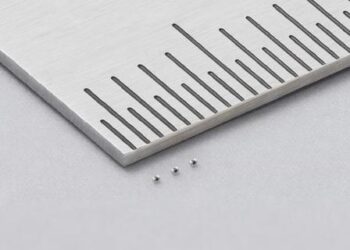
Apple’s previous patents offer some indication of the engineering challenges involved. One patent describing a foldable smartphone refers to glass that could be locally thinned to between 10 and 50 microns at the folding region.
Glass that thin would have to be processed with considerable precision. A microscopic crack introduced during manufacturing could become a failure point after repeated folding. The flexible plastic layer beneath the display faces a similar risk: a rough or heat-damaged edge could eventually develop into a tear.
The issue is not limited to the display.
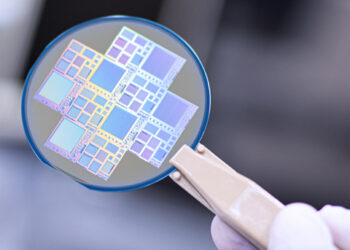
Foldable smartphones combine ultra-thin glass and flexible display layers with printed circuit boards, ceramics and semiconductor components. Many of those parts must be cut, drilled or otherwise processed without damaging neighboring structures.
Femtosecond lasers are also used in OLED manufacturing, where precision is important because a panel consists of multiple layers, including organic light-emitting materials, circuitry and protective films. Excessive heat during processing can damage those layers.
The technology is gaining relevance as electronics manufacturers pursue smaller components and increasingly dense designs. Semiconductor production and equipment used in data centers are among other areas where demand for high-precision laser processing is growing, according to LITILIT.
The challenge for laser manufacturers, however, is scaling their own production.
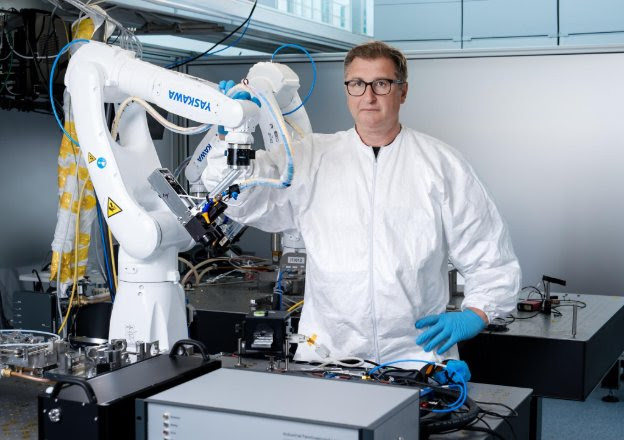
Femtosecond laser systems have traditionally required specialized expertise and complex components. LITILIT says it has designed its systems around a modular architecture and greater automation to reduce manufacturing complexity and accelerate production.
The company was founded by Gavrilinas, Kęstutis Regelskis and Nerijus Rusteika, with its technology developed in collaboration with Lithuania’s Center for Physical Sciences and Technology, or FTMC.
LITILIT says its laser architecture achieves about 20% electrical-to-optical efficiency.
In June, the company began construction of a high-capacity femtosecond laser factory in Vilnius. Production is expected to begin within months. LITILIT plans to manufacture about 1,000 lasers in its first year and eventually increase annual capacity to 3,000 units.
It also plans to expand production into other countries through international partnerships.
For Apple, the significance of precision manufacturing will ultimately be measured in the durability of the finished product. A foldable phone can have an elegant hinge and a sophisticated display, but microscopic weaknesses introduced during production could become visible only after months or years of use.
That makes manufacturing a critical part of the foldable-phone race. As Apple and its rivals push materials closer to their physical limits, the ability to repeatedly produce components at microscopic tolerances could determine whether foldable devices remain a niche category or become a durable mainstream product.