

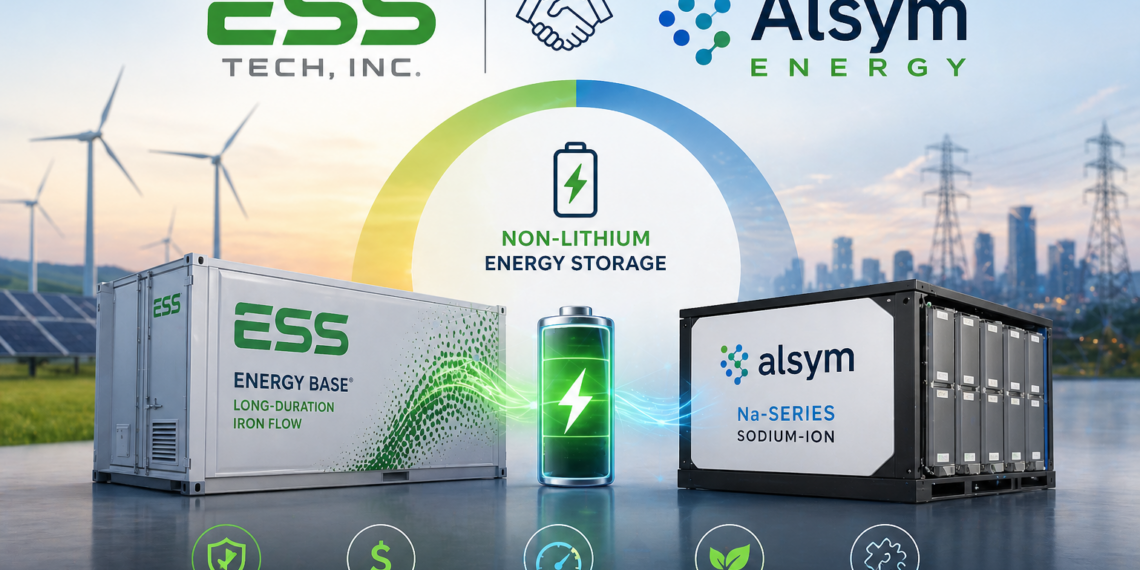
Energy storage company ESS Tech, Inc. (NYSE: GWH) has announced a strategic partnership with Alsym Energy to expand its non-lithium battery portfolio. The agreement includes a planned addition of 8.5 GWh of sodium-ion battery cells and modules.
The partnership is structured through a letter of intent. It marks ESS’s entry into the short- and medium-duration battery energy storage system (BESS) market. This segment has traditionally been dominated by lithium-ion technologies.
The move broadens ESS’s existing focus on long-duration energy storage. It positions the company to address a wider range of grid and commercial applications.
Alsym’s sodium-ion technology is designed for applications typically served by lithium-ion batteries. It also targets use cases where lithium systems face limitations. A key feature is the elimination of thermal runaway risk. This is a major safety concern associated with lithium-based chemistries.
The sodium-ion solution is also designed to reduce system complexity. It does not require extensive heating, ventilation, and air conditioning systems. This lowers infrastructure requirements. It also contributes to a lower total cost of ownership.
The batteries offer high round-trip efficiency. They support fast charge and discharge cycles. This enables rapid response in energy storage applications such as grid balancing and peak demand management.
Drew Buckley, Chief Executive Officer of ESS, said the partnership reflects a broader strategy to build a diversified storage platform. He noted that sodium-ion and iron flow technologies serve different operational needs.
“Alsym’s sodium-ion technology supports short- and medium-duration use cases that require fast cycling and high power,” said Drew Buckley. “Our iron flow systems are designed for long-duration storage, where reliability and extended discharge are critical.”
ESS’s Energy Base® platform is based on iron flow chemistry. It is designed for storage durations ranging from eight to 24 hours. The system is used in applications that require sustained energy delivery, including renewable energy integration.
The addition of sodium-ion technology allows ESS to address shorter-duration needs. These include applications that require quick energy dispatch and frequent cycling. The combined portfolio enables hybrid deployments across different timeframes.
Randall Selesky, Chief Commercial Officer at ESS, described the agreement as a key milestone. He said the partnership supports the company’s goal of becoming a full-spectrum, non-lithium energy storage provider.
“This partnership gives customers an alternative to lithium-ion systems,” said Randall Selesky. “It combines performance, safety, and cost efficiency without increasing system complexity.”
Alsym’s sodium-ion batteries are designed to be non-combustible. They are also thermally stable. This reduces the need for fire suppression systems. It simplifies deployment in large-scale installations.
The company said its battery technology is developed using a proprietary, physics-informed artificial intelligence platform. This approach accelerates development cycles. It also supports faster commercialisation.
The batteries use materials that are not sourced from foreign entities of concern (FEOC). This addresses supply chain risks. It also aligns with growing industry focus on sourcing transparency and security.
Mukesh Chatter, Chief Executive Officer of Alsym Energy, said the partnership reflects changing market dynamics. He noted that demand for alternatives to lithium-ion technology is increasing.
“The industry is looking for solutions that can scale safely and efficiently,” said Mukesh Chatter. “This partnership brings together system integration and battery innovation to meet that demand.”
ESS said the combined platform will support a wide range of customers. These include utilities, independent power producers, data centres, and commercial and industrial users. The solutions are designed to be flexible and scalable across different applications.