

Thailand has launched a national roadmap for using artificial intelligence to raise industrial productivity, as slowing labor-productivity growth and an aging population increase pressure on businesses to produce more with fewer resources.
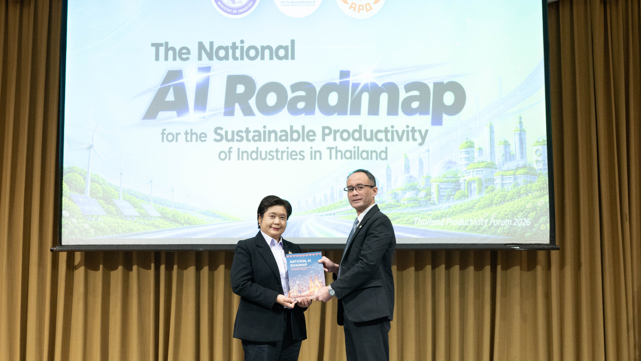
The National AI Roadmap for the Sustainable Productivity of Industries in Thailand was formally handed over and disseminated at the Thailand Productivity Forum 2026, held alongside the first AI Productivity Collaboration Consortium.
The roadmap, supported by the Asian Productivity Organization (APO), takes a productivity-first approach to AI adoption. Rather than treating the deployment of AI systems as an end in itself, it calls for businesses and public institutions to measure the technology through outcomes such as higher output, lower downtime and waste, improved quality and better use of energy, materials and capital.
“AI is not the objective. Productivity is,” said Dr. Indra Pradana Singawinata, Secretary-General of the APO.
The economic backdrop is challenging. Data from the APO Productivity Database 2025 shows that Thailand’s average labor-productivity growth fell to 2.1% during 2015-2023 from 4.8% during 2010-2015. Total factor productivity recorded average growth of zero over the 2015-2023 period.
With demographic changes expected to constrain growth in the labor force, improving output from existing workers and capital is becoming increasingly important for Thailand’s economy.
Deputy Permanent Secretary of the Ministry of Industry Duangdow Khawjaroen said productivity should be measured through tangible improvements, including lower costs and waste and greater value generated from available resources.
She also emphasized the importance of data infrastructure, saying effective AI adoption depends on reliable underlying data. The ministry is already using platforms including i-Industry and i-SingleForm, while potential industrial applications include predictive maintenance, energy optimization, supply-chain analysis, real-time quality inspection, greenhouse-gas assessment and executive decision-making.
The roadmap was developed jointly by the Thailand Productivity Institute (FTPI) and APO, with technical support from FutureLab. Its recommendations draw on 23 stakeholder interviews, a strategy workshop and practical AI training.
Among its proposed targets for the Ministry of Industry are a 15% productivity increase by 2030 across specified MIND priority sectors, AI adoption by at least 60% of large enterprises and 40% of small and medium-sized enterprises in key sectors, and at least 80 targeted AI pilot projects.
The roadmap recommends that 30% of those pilots progress into full production. It also proposes certification of at least 50,000 industrial workers and 5,000 AI specialists by 2030.
Thailand already has examples of AI and digital technologies delivering measurable industrial gains.
In 2025, the World Economic Forum added Midea’s Si Racha manufacturing facility to its Global Lighthouse Network. The plant had deployed 72 digital and AI solutions, with reported outcomes including a 43% reduction in order lead time, a 32% decline in customer complaints and a 62% improvement in the speed of employee qualification.
The example highlights a broader issue facing Thailand: scaling successful applications beyond individual factories and large enterprises.
According to the 2024 AI Readiness study conducted by the Electronic Transactions Development Agency (ETDA) and the National Science and Technology Development Agency (NSTDA), 580 organizations participated in the survey. Only 17.8% said they were already using AI, while 73.3% planned to adopt it in the future.
That gap points to the next stage of Thailand’s AI strategy. Moving from planned adoption to measurable economic value will require companies to identify commercially relevant use cases, prepare their data, redesign workflows and train employees, while integrating AI into existing operations.
For smaller businesses in particular, access to skills, data and investment could determine whether AI adoption translates into productivity gains or remains limited to experimentation.
The roadmap is aligned with the APO Vision 2030 and Thailand’s Strategic Partnership Program. Its implementation will test whether the country can shift from isolated AI projects toward a broader productivity-driven transformation.
For Thailand, the measure of success will ultimately be economic rather than technological. The critical question is whether AI can help companies increase output, reduce resource consumption, strengthen workers’ capabilities and improve competitiveness at scale.
As the country moves from AI planning to deployment, productivity will provide the benchmark against which its transformation is judged.